You’ve been climbing in the same pair of indoor rock climbing shoes for months, maybe over a year. They feel comfortable now, broken in perfectly.
But here’s the problem: that comfort might be costing you progress. Worn-out shoes don’t just slip more—they actively teach you bad habits that stick around long after you finally buy new ones.
Most climbers wait way too long to replace their shoes, and their footwork suffers for it.
What Actually Wears Out on Climbing Shoes?
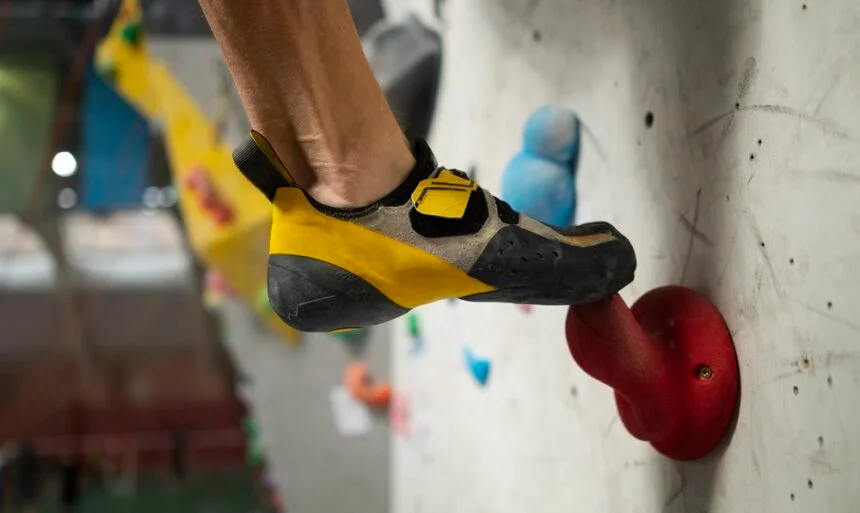
The rubber on the toe and ball of your foot takes the most abuse. Every time you press into a hold or scrape up a volume, you’re grinding away microscopic layers of rubber.
Indoor climbing is actually harder on shoes than outdoor climbing in some ways because gym holds have textured surfaces specifically designed to create friction.
The rand—that rubber strip wrapped around the toe—wears down too, especially if you do a lot of toe hooks or drag your feet while climbing. Once the rand gets thin enough, the structural integrity of the whole shoe starts to fail.
The heel cup is another weak point. It compresses over time from repeated heel hooks and takes on a permanent deformed shape. When that happens, your heel hooks become mushy and unreliable.
Most climbers can get about 3 to 6 months of regular use from a pair of shoes before they need resoling or replacement.
If you’re climbing 3-4 times a week, you’re probably on the shorter end of that range. Weekend warriors might stretch it to 8-9 months.
How Thick Should the Rubber Actually Be?
New climbing shoes typically have 4 to 5 millimeters of rubber on the sole. When you’re down to 2mm or less, you’re in the danger zone. But here’s the catch: you can’t easily measure this while the shoe is on your foot.
The simplest test is the thumbnail test. Press your thumbnail into the rubber on the ball of your foot.
If you can feel the plastic or fabric underneath through the rubber, you’re past due for new shoes. On a new shoe, the rubber should feel thick enough that you can’t detect anything underneath it.
Another sign is smooth rubber. Fresh climbing shoe rubber has a slightly textured surface. Once it gets worn smooth and shiny, the friction properties change significantly. You’ll notice you need to press harder into holds to get the same grip.
What Happens to Your Footwork When Shoes Wear Out?
This is where it gets serious. Worn shoes don’t just make climbing harder—they make you climb worse.
When your rubber gets thin, you lose the ability to feel small edges clearly. Your brain compensates by making you press harder into every foothold.
You start muscling through moves that should be about balance and precision. A 2019 study from the University of Colorado found that climbers using worn shoes gripped footholds with 18% more force on average compared to when they used new shoes on the same routes.
You also start developing what climbers call “lazy feet.” Because your worn shoes slip more easily, you subconsciously start relying more on your hands.
You don’t trust your feet anymore, so you pull harder with your arms. This becomes a habit that persists even after you get new shoes.
Bad footwork habits can take months to unlearn. If you’ve been climbing in dead shoes for half a year, don’t expect your technique to instantly improve when you finally upgrade. Your muscle memory has adapted to compensating for poor equipment.
| Wear Level | Rubber Thickness | Performance Impact | Footwork Changes |
| New | 4-5mm | Optimal grip and feel | Precise, confident placement |
| Moderate wear | 2-3mm | Slight reduction in sensitivity | Minor compensation needed |
| Heavily worn | 1-2mm | Significant grip loss | Over-gripping, increased arm use |
| Dead | Under 1mm | Dangerous slipping | Complete technique breakdown |
Can You Actually See the Damage?
Sometimes yes, sometimes no. The obvious signs are holes in the rubber or spots where you can see the rand fabric underneath. If there’s a hole, the shoe is done—don’t even bother resoling at that point.
But shoes can be functionally dead before they look terrible. Check the toe area from the side. If the rubber looks compressed or there’s a visible gap between the rand and the sole rubber, the shoe has lost its structure.
Look at the heel too. If it’s visibly collapsed inward or outward, or if you can squeeze it easily with your fingers, the heel is shot. New shoes have firm, supportive heels that hold their shape.
The smell test isn’t about wear, but it matters. If your shoes smell so bad that you’re embarrassed to take them off in public, other climbers notice.
More importantly, that smell indicates bacterial growth that’s breaking down the materials inside the shoe. The insole and lining deteriorate faster when shoes are consistently soaking with sweat.
When Should You Resole vs. Replace Your Indoor Rock Climbing Shoes?
Resoling costs about $40 to $65 depending on the shop and whether you need rand work. New shoes cost $80 to $180 for most models. So resoling makes financial sense if you catch the wear early enough.
You can resole shoes when: the rubber is worn down but there are no holes, the rand is still intact, and the upper material isn’t destroyed. Basically, if the only problem is thin rubber, resoling works.
You need new shoes when: there are holes through the sole, the rand is torn or separated, the heel is permanently deformed, or the upper material is ripping apart. Once the structural components fail, resoling won’t fix it.
Here’s something most people don’t know: you should send shoes for resoling before the rubber is completely gone.
If you wait until there are holes, the resoler has to rebuild the entire toe structure, which costs more and doesn’t work as well. The ideal time to resole is when you’re down to about 2mm of rubber.
What’s the Real Cost of Waiting Too Long?
Let’s talk money. If you destroy a pair of shoes to the point where they can’t be resoled, you just lost $80-180. If you’d sent them in when they still had 2mm of rubber left, you’d have paid $50 for a resole and gotten another 3-6 months of use.
But the bigger cost is progress. When you’re climbing on worn shoes, you’re practicing bad technique. You’re training your body to over-grip, to rely on upper body strength, and to not trust your feet. That’s setting you back in ways that are hard to measure but very real.
Professional climbers replace or resole their shoes constantly for exactly this reason. They know that maintaining good footwork is more important than squeezing a few extra sessions out of dying shoes.

How Often Should You Check Your Shoes?
Make it a habit to inspect your shoes every few weeks. Just take a minute after your session to look at the soles, check the rand, and squeeze the heel. Once you start seeing significant wear, check them every session.
If you notice you’re slipping on holds that used to feel secure, that’s your shoes telling you something. Don’t ignore it.
Same thing if your heel hooks suddenly feel less stable or if you find yourself having to try harder on routes you’ve already done.
The hard truth is that most climbers are climbing in shoes that are past their prime right now.
If you can’t remember the last time you bought new shoes or sent them for resoling, there’s a good chance you’re in this category.
Your climbing shoes should be tools that help you progress, not obstacles you’re fighting against. When they stop doing their job, it’s time to move on.
Frequently Asked Questions
How long do indoor climbing shoes actually last?
Answer: Most climbers get 3–6 months of regular indoor use before shoes need resoling or replacing. If you climb 3–4 times per week, expect wear on the shorter end. Weekend climbers may stretch them to 8–9 months.
How can I tell if the rubber on my climbing shoes is too worn?
Answer: If the rubber is 2mm or thinner, smooth and glossy, or you can feel the underlying material with your thumbnail, the shoes are overdue for replacement or resoling.
What happens to my climbing technique when my shoes are worn out?
Answer: You lose grip and sensitivity, causing you to over-grip holds, rely more on your arms, and develop lazy feet. These bad habits stick around even after you buy new shoes.
Should I resole my climbing shoes or buy new ones?
Answer: Resole if the rubber is thin but the rand, heel, and upper material are still intact. Replace if you see holes, tearing, collapsed heels, or structural failure—resoling can’t fix that.
Why is waiting too long to replace shoes a problem?
Answer: Besides losing $80–$180 by ruining shoes beyond repair, you’re also training bad footwork. Worn shoes force you to press harder, slip more, and rely on strength instead of technique.
About the Author