

Comfortable medical scrubs combine appropriate fabric weight, airflow, stretch recovery, functional fit, and practical storage. Breathability alone is not enough. A scrub set may use lightweight fabric but still feel uncomfortable if the shoulders pull, the waistband rolls, the inseam is incorrect, or loaded pockets cause the garment to shift.
Healthcare professionals should evaluate scrubs as a complete workwear system. The fabric, top design, pant construction, pockets, layers, footwear, work environment, and laundering routine all affect how the uniform performs over a long shift.
Key Takeaways
- Lightweight fabric can reduce bulk, but it must still provide suitable coverage and durability.
- Stretch should support movement and return to its original shape afterward.
- A breathable scrub top needs enough room through the shoulders, back, chest, and underarms.
- Comfortable scrub pants depend on waistband design, rise, thigh room, leg shape, and inseam.
- Pocket placement and carried weight can affect the fit of both tops and pants.
- Removable layers are usually more adaptable than one heavy uniform.
- Fabric composition is useful, but it does not fully explain how a garment will feel.
- Scrubs should be tested while sitting, walking, bending, reaching, and carrying normal work items.
- Care instructions and workplace laundering policies should be reviewed before purchase.
Why Does Scrub Comfort Matter During Long Shifts?
Healthcare work may involve prolonged standing, repeated walking, seated documentation, bending, reaching, and changes between warmer and cooler environments.
The National Institute for Occupational Safety and Health provides dedicated training on shift work and long work hours for nurses. Its guidance explains that long work hours increase exposure to workplace demands and reduce recovery time. Comfortable clothing cannot prevent fatigue, but it can help avoid adding unnecessary restriction, pressure, heat, or repeated adjustment to an already demanding workday.
Poorly selected scrubs may become distracting because of:
- Tightness through the shoulders
- Fabric collecting behind the knees
- Waistband pressure while sitting
- Pants slipping under pocket weight
- Excess material around the lower leg
- A neckline that shifts while bending
- Heavy layers that feel bulky
- Seams rubbing during repeated movement
The objective is not to find clothing that feels invisible under every condition. It is to select a uniform that creates as few avoidable distractions as possible.
What Does “Breathable” Mean in Medical Scrubs?
“Breathable” is often used as a broad apparel term. In practical use, it generally describes how comfortably heat and moisture can move away from the body through the garment and its openings.
Several factors influence this experience:
- Fabric weight
- Textile construction
- Garment fit
- Air space between the body and clothing
- Number of layers
- Workplace temperature
- Physical activity
- Personal temperature preference
A fabric can feel light without feeling especially airy. Another may feel soft and fluid but become warm when layered. A third may have excellent stretch but fit so closely that it limits airflow around the body.
For this reason, breathability should be evaluated as a combination of fabric and garment design, not as a single product claim.
Breathability is not the same as thinness
Thin material is not automatically the most comfortable choice.
An extremely thin fabric may create concerns related to:
- Opacity
- Durability
- Pocket support
- Shape retention
- Workplace coverage
- Visible underlayers
The better question is whether the scrub fabric provides enough coverage and structure without creating unnecessary weight.
Breathability is not the same as moisture absorption
Some fabrics absorb moisture into their fibers, while others move moisture across or away from the surface differently.
The practical wearer experience can depend on:
- How quickly the garment feels dry again
- Whether the fabric clings when warm
- Whether it becomes heavy after absorbing moisture
- How much air circulates through the cut
- Whether additional layers trap heat
Rather than relying on one marketing phrase, healthcare professionals should examine the full fabric description and evaluate the garment in realistic conditions.
How Does Fabric Composition Affect Scrub Comfort?
Federal textile rules require many apparel products sold in the United States to disclose the generic names and percentages of their constituent fibers. The Federal Trade Commission’s guidance on textile fiber labeling can help shoppers understand what information should appear on apparel labels.
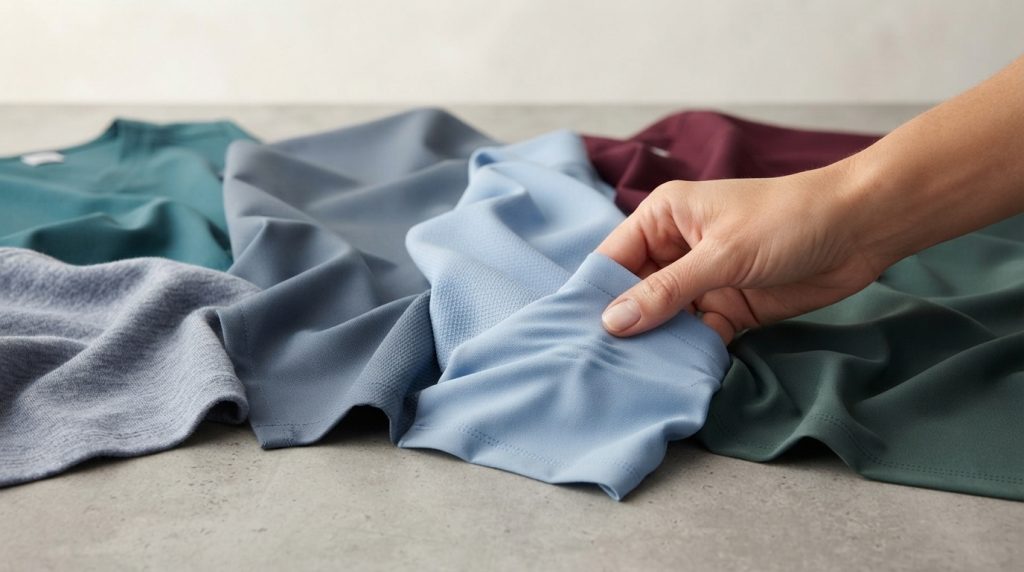
Common fibers found in medical scrubs include:
- Polyester
- Cotton
- Rayon or viscose
- Nylon
- Spandex or elastane
Fiber percentages are useful, but they do not tell the entire story. Fabric weight, weave, knitting method, surface finish, and garment construction also influence how the scrubs feel.
Two scrub sets with similar fiber percentages may have noticeably different:
- Softness
- Stretch
- Drape
- Airflow
- Weight
- Surface texture
- Wrinkle behavior
- Shape recovery
Polyester-rich scrub fabrics
Polyester is commonly used in work apparel because it can contribute to:
- Shape retention
- Faster drying
- Wrinkle resistance
- Smooth texture
- Color consistency
- Relatively easy care
A polyester-rich fabric may feel lightweight and practical, or it may feel dense and warm. The percentage alone does not determine comfort.
Shoppers should also examine the fabric’s weight, stretch, texture, and fit.
Cotton-blend scrubs
Cotton can contribute:
- A familiar textile feel
- Surface softness
- Moderate structure
- A less slick texture
- Comfortable contact with the skin
The trade-offs may include longer drying times, greater wrinkling, or possible shrinkage depending on the fabric construction and care method.
A cotton blend may be appealing to professionals who prioritize softness, but the actual garment should still be tested for movement and temperature comfort.
Rayon or viscose blends
Rayon-type fibers can contribute:
- Softness
- Fluid drape
- Flexibility
- A smooth surface
- Comfortable movement
A highly fluid fabric may feel pleasant but less structured than some professionals prefer.
It is important to check whether the garment:
- Holds its shape
- Clings during movement
- Supports loaded pockets
- Maintains appropriate coverage
- Performs well after repeated washing
Nylon blends
Nylon may be used in performance-oriented fabrics to support:
- Durability
- Smoothness
- Flexibility
- Lightweight construction
- Abrasion resistance
Its actual feel depends heavily on the rest of the blend and textile construction.
Spandex or elastane
A relatively small amount of stretch fiber can improve mobility.
However, more stretch is not always better. Excessive elasticity can create a highly body-following fit or allow pockets and knees to sag if the fabric lacks sufficient recovery.
What Is Stretch Recovery, and Why Does It Matter?
Stretch describes how far a fabric can extend. Recovery describes how effectively it returns to its original shape.
For long-shift workwear, recovery is often as important as flexibility.
A scrub fabric with poor recovery may gradually become loose at:
- The knees
- Elbows
- Seat
- Waistband
- Pocket openings
- Lower hem
This can make the uniform feel less secure as the day continues.
A simple stretch recovery test
When examining fabric in person:
- Gently stretch a small section.
- Hold it briefly.
- Release the material.
- Observe whether it returns to its original shape.
- Check whether the fabric becomes unusually thin or transparent under tension.
When shopping online, review:
- Fiber composition
- Stretch description
- Garment cut
- Product photographs
- Repeated customer comments about sagging or shape retention
Garment cut changes how much stretch is needed
A relaxed straight-leg pant may not require the same level of elasticity as a slim jogger.
Likewise, a generously cut scrub top may offer mobility through its shape, while a more fitted top may depend more heavily on stretch panels or flexible fabric.
Stretch and cut should therefore be evaluated together.
How Should Breathable Scrub Tops Fit?
A scrub top cannot feel breathable if it is overly restrictive through the upper body.
Professionals evaluating breathable scrub tops should look beyond fabric claims and check how the complete top fits through the shoulders, back, underarms, chest, and hips.
Shoulder and upper-back room
The shoulders and upper back are major movement areas.
A scrub top may be too restrictive if it:
- Pulls strongly when both arms reach forward
- Feels tight under the arms
- Lifts excessively during overhead reaching
- Forces the neckline upward
- Restricts upper-body rotation
A larger size is not always the correct solution. The problem may be the shoulder shape, armhole construction, or overall cut.
Underarm fit
Tight armholes can create friction and reduce freedom of movement.
However, excessively low or wide armholes may:
- Shift while reaching
- Create extra fabric
- Affect coverage
- Make layering awkward
The best armhole provides movement without unnecessary looseness.
Chest and torso room
A close-fitting top may feel warmer if there is little air space between the fabric and body.
A very loose top may improve airflow but create other problems, such as:
- Excess fabric
- Unstable pockets
- Bunching under jackets
- Shifting necklines
- Interference with pant pockets
The ideal fit provides controlled room without appearing oversized.
Side vents
Side vents can improve mobility around the hips and lower torso.
They may be especially useful when:
- The scrub top extends below the hip
- The wearer sits frequently
- The top has a more structured fabric
- Additional room is needed through the lower body
Top length
A short top may rise while reaching or bending.
An excessively long top may:
- Cover pant pockets
- Bunch while sitting
- Pull across the hips
- Add heat under an outer layer
Top length should be evaluated while standing, sitting, and reaching.
Which Neckline Is Most Comfortable?
Neckline preference is personal, but the shape also influences coverage, airflow, and movement.
Common options include:
- V-neck
- Round neck
- Mock-wrap
- Notched neck
- Y-neck
- Zip-neck
- Collar-inspired styles
V-neck scrub tops
V-neck tops can provide an open neckline and may feel less restrictive around the neck.
The depth should be checked while leaning forward, particularly when the professional does not normally wear an underscrub.
Round-neck scrub tops
Round necklines may provide more upper-chest coverage.
A narrow opening can feel restrictive if the neckband lacks flexibility.
Mock-wrap and notched necklines
These styles can combine visual shaping with moderate coverage.
The overlapping or structured areas should remain flat rather than pulling during movement.
Zip-neck or collared tops
These designs may offer adjustable coverage or a more structured appearance.
Check whether the zipper, collar, or neckline edge causes pressure while sitting or bending.
What Makes Scrub Pants Comfortable?
Scrub-pant comfort depends on more than soft fabric.
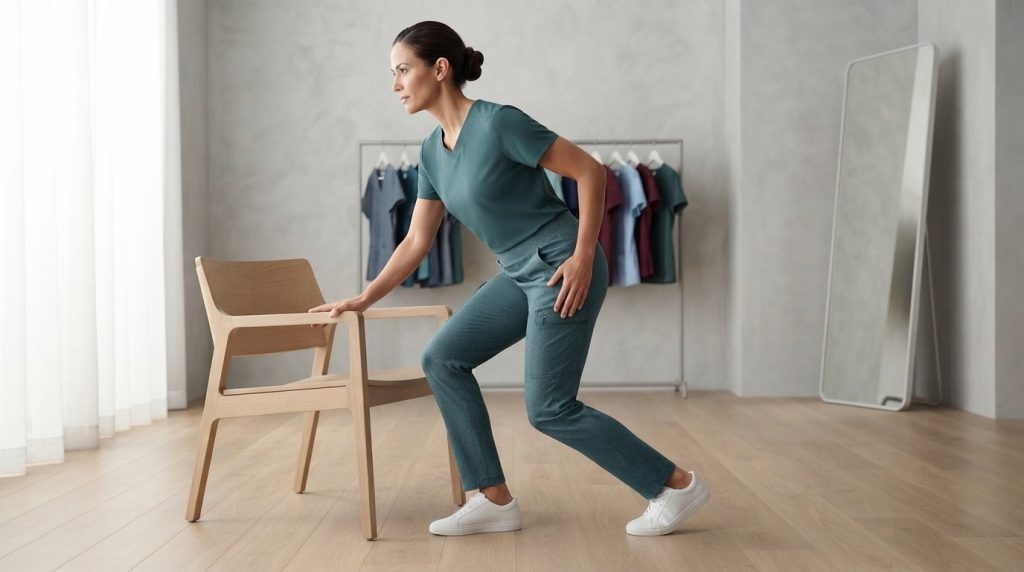
Professionals choosing comfortable scrub pants should evaluate:
- Waistband design
- Rise
- Hip room
- Thigh room
- Knee placement
- Leg shape
- Inseam
- Pocket weight
- Fabric recovery
A pant may feel comfortable while standing but become restrictive during sitting, bending, or walking.
Which Waistband Is Best for Long Shifts?
No single waistband design is best for every wearer.
Full elastic waistbands
A full elastic waistband provides consistent support around the waist.
It should remain secure without:
- Digging into the body
- Folding over
- Rolling downward
- Creating excessive pressure while sitting
Drawstring waistbands
A drawstring allows manual adjustment.
This can be helpful when:
- The waist falls between standard sizes
- Pocket weight changes during the shift
- The wearer prefers adjustable tension
The knot should lie comfortably beneath the scrub top.
Yoga-style knit waistbands
A wide knit waistband spreads pressure across a larger area.
It may feel softer during sitting, but it needs enough recovery to avoid rolling or slipping.
Elastic-and-drawstring combinations
A hybrid waistband provides both stretch and adjustment.
This construction can be useful when pants carry phones, tools, or other permitted work items.
Flat-front waistbands
A flat-front design may provide a tailored appearance.
The back or sides may still include elastic for movement.
The front closure should remain comfortable during sitting and bending.
How Does Rise Affect Comfort?
Rise describes how the pants fit between the waistband and crotch.
Common descriptions include:
- Low rise
- Mid rise
- Natural rise
- High rise
These terms are not perfectly standardized across brands or collections.
A rise may be too short when:
- The pants pull during sitting
- The waistband slides downward when bending
- The crotch feels restrictive
- The back coverage feels inadequate
A rise may be too long when:
- Fabric bunches below the waistband
- The seat feels loose
- The crotch hangs lower than intended
- The pants shift while walking
Body proportions matter more than the marketing label. Two people of the same height may need different rises.
How Does Scrub-Pant Style Affect Airflow and Movement?
Jogger scrub pants
Joggers taper toward the ankle and often include a cuff.
They reduce loose fabric near the lower leg but may feel warmer around the ankle or calf if the fit is very close.
Check:
- Calf room
- Cuff pressure
- Thigh mobility
- Rise
- Inseam
Tapered scrub pants
Tapered pants narrow gradually toward the ankle without necessarily using a cuff.
They can provide a streamlined shape while leaving more airflow around the lower leg than a closely fitted jogger.
Straight-leg scrub pants
Straight-leg pants maintain a more consistent width from the thigh downward.
They may provide:
- Additional calf room
- Less fabric contact with the lower leg
- A traditional professional appearance
Cargo scrub pants
Cargo pants add storage along the thigh.
They can be practical, but heavily loaded pockets may:
- Pull the waistband downward
- Swing while walking
- Add warmth and bulk
- Create uneven pressure
Flare and bootcut scrub pants
These styles widen below the knee.
They may provide more room around the calf but require careful inseam selection to prevent the hem from dragging.
Why Does Inseam Length Affect Comfort?
Incorrect pant length can create bunching, dragging, or pulling.
Common length categories include:
- Petite
- Short
- Regular
- Tall
The exact inseam associated with each label varies by collection.
Pants that are too long may:
- Collect around the ankle
- Drag near the floor
- Bunch behind the knee
- Interfere with footwear
Pants that are too short may:
- Pull upward significantly when sitting
- Expose more ankle than intended
- Position shaped knees incorrectly
- Feel tight through the rise
The most reliable approach is to measure the inseam of a work pant that already fits well and compare it with the specific product chart.
Can Pockets Make Scrubs Less Comfortable?
Yes. Pockets add function, but they can also change how the garment fits.
A scrub set should be evaluated both empty and with the lightweight items normally carried.
Common scrub-top pockets
- Chest pockets
- Lower patch pockets
- Interior compartments
- Pen slots
- Zippered pockets
- Hidden phone pockets
Common scrub-pant pockets
- Front slash pockets
- Back pockets
- Cargo pockets
- Zippered thigh pockets
- Small utility compartments
Problems caused by overloaded pockets
Too much weight may cause:
- The neckline to pull forward
- One side of the top to hang lower
- The waistband to slip
- The pant leg to twist
- Items to press against the body while sitting
- Fabric to stretch permanently around pocket openings
The best pocket layout is not necessarily the one with the highest number of compartments.
A more useful approach is to list what is carried during a normal shift and select pockets that place those items securely and comfortably.
How Can Layering Improve Temperature Comfort?
Healthcare environments can vary in temperature throughout the day.
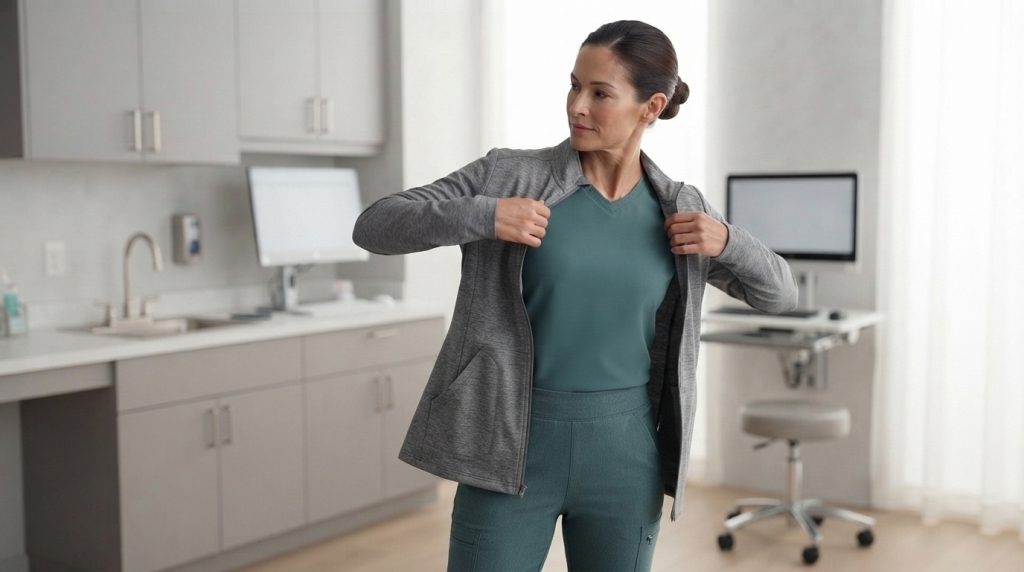
A professional may move between:
- Patient rooms
- Hallways
- Administrative areas
- Examination rooms
- Break areas
- Outdoor travel
- Cooler procedure spaces
A lightweight base scrub set combined with a removable outer layer can provide more flexibility than one heavy uniform.
A lightweight scrub jacket should provide warmth without restricting shoulder movement or blocking access to important pockets.
Features to examine in a scrub jacket
- Fabric weight
- Shoulder flexibility
- Sleeve length
- Cuff design
- Closure type
- Pocket placement
- Jacket length
- Compatibility with the scrub top
- Ease of removal
Check the complete layered outfit
A scrub top that fits correctly by itself may become tight under a jacket.
Test the combination by:
- Reaching forward
- Raising both arms
- Sitting
- Crossing the arms
- Accessing pockets
- Rotating the shoulders
Scrub jackets are not protective equipment
A normal scrub jacket is a clothing layer. It should not be treated as a replacement for gowns, gloves, masks, eye protection, or other PPE required by the facility.
How Should Work Setting Influence Fabric Choice?
Hospitals and emergency settings
Healthcare professionals in active hospital environments may prioritize:
- Lightweight fabric
- Stretch recovery
- Secure storage
- Easy layering
- Durable seams
- Stable waistbands
The ideal choice depends on department requirements and whether personal scrub garments are permitted.
Outpatient clinics
Clinic workwear may place greater emphasis on:
- Professional structure
- Coordinated appearance
- Seated comfort
- Moderate pocket storage
- Wrinkle resistance
Long-term care
Long-term care professionals may need:
- Flexible knees and hips
- Stable waistbands
- Comfortable walking fit
- Practical pocket access
- Easy-care fabric
Patient movement should always follow safe workplace procedures. OSHA emphasizes that lifting and transfer equipment are central to reducing risks associated with moving, transferring, or repositioning patients. Stretch clothing may support ordinary movement, but it does not replace a safe patient-handling program.
Dental and veterinary settings
Professionals in dental or veterinary environments may spend time leaning, sitting, bending, or working in close positions.
Useful features may include:
- Secure neckline coverage
- Shoulder flexibility
- Comfortable seated fit
- Easy-care surfaces
- Pockets that do not interfere with movement
Home healthcare
Home healthcare professionals may travel between different temperatures and environments.
They may prioritize:
- Wrinkle resistance
- Removable layers
- Secure pockets
- Comfortable driving fit
- Fabric that maintains its appearance throughout the day
How Do Underscrubs Affect Breathability?
An underscrub changes the total clothing system.
Even when the outer scrub fabric is lightweight, a thick or closely fitted base layer may increase warmth.
When choosing an underscrub, consider:
- Fabric weight
- Sleeve length
- Neckline compatibility
- Seams
- Moisture comfort
- Fit beneath the scrub top
The outer scrub top should have enough room to accommodate the base layer without becoming restrictive.
Professionals who regularly wear underscrubs should test garments together rather than purchasing each layer separately.
Do Dark and Light Scrub Colors Feel Different?
Color can affect the visual appearance and workplace suitability of scrubs, but temperature comfort is also influenced by:
- Fabric weight
- Lighting
- Direct sun exposure
- Indoor climate control
- Layers
- Activity level
- Garment fit
In most indoor healthcare settings, fabric and layering decisions are likely to be more immediately noticeable than color alone.
Color selection should primarily follow:
- Employer requirements
- Department codes
- School policies
- Embroidery rules
- Professional presentation needs
Before ordering several sets, confirm the exact approved shade because similarly named colors may differ among collections.
How Does Repeated Washing Affect Comfort?
Scrubs may be washed much more frequently than ordinary clothing.
Over time, washing and drying can affect:
- Fabric softness
- Elastic recovery
- Waistband tension
- Color
- Surface texture
- Shrinkage
- Seam condition
- Zippers and closures
Always follow both the garment care label and workplace requirements.
The CDC’s environmental infection-control guidance notes that healthcare laundry may include uniforms and scrub suits. It also emphasizes careful handling of healthcare textiles and adherence to appropriate facility procedures.
Routine care considerations
- Empty every pocket before washing.
- Close closures when directed by the manufacturer.
- Separate colors when recommended.
- Use the stated wash temperature.
- Avoid excessive dryer heat when prohibited.
- Inspect waistbands and seams regularly.
- Replace garments that no longer maintain an appropriate fit.
Personal laundering choices should never override employer or infection-control policies.
How Can Scrubs Be Tested Before a Long Shift?
Scrubs should not be evaluated only while standing.
The long-shift scrub test
Wear the complete uniform with normal underlayers and typical work shoes.
Then:
- Walk for several minutes.
- Sit fully in a chair.
- Reach both arms forward.
- Reach overhead.
- Bend carefully.
- Squat or lower the body slightly.
- Raise one knee.
- Rotate the upper body.
- Place normal lightweight items in the pockets.
- Put on the jacket or lab coat normally worn.
Check the scrub top
Confirm that:
- The shoulders remain comfortable
- The neckline stays in position
- The top does not rise excessively
- The fabric does not pull across the back
- The pockets remain accessible
- The underarms do not rub
Check the scrub pants
Confirm that:
- The waistband remains secure
- The rise feels comfortable while sitting
- The hips and thighs allow movement
- The knees do not feel restricted
- The hem does not drag
- Pocket weight does not pull the pants downward
Professionals who need help comparing fabric weight, garment cut, and inseam options may benefit from visiting an in-person medical scrub store in Lincoln before building a complete workwear rotation.
Common Mistakes When Choosing Breathable Scrubs
Selecting the thinnest fabric available
Thin fabric may sacrifice opacity, structure, durability, or pocket support.
Looking only at fiber percentages
Composition does not fully explain fabric weight, weave, finish, or garment construction.
Assuming more stretch means more comfort
A highly elastic fabric can still fit poorly or lose its shape.
Ignoring the waistband
A breathable pant can remain uncomfortable if the waistband rolls, slips, or creates pressure.
Choosing a tight fit to reduce bulk
A very close fit may restrict movement and reduce air space around the body.
Overloading pockets
Heavy pockets can distort the garment and create uneven pressure.
Wearing too many permanent layers
A removable jacket usually offers more temperature flexibility than stacking several layers that cannot be adjusted easily.
Buying multiple sets before testing one
Wear one new set through a normal workday before purchasing a complete rotation.
Ignoring care instructions
Incorrect drying temperature or laundering practices may affect fabric, elastic, fit, and garment lifespan.
How to Build a Comfortable Scrub Rotation
Once a reliable combination has been found, record the details.
Save:
- Scrub-top style
- Top size
- Neckline
- Top length
- Pant style
- Pant size
- Rise
- Inseam
- Waistband type
- Fabric composition
- Preferred fabric weight
- Pocket configuration
- Approved work color
- Jacket or underscrub compatibility
A practical rotation may include:
- Several lightweight core scrub sets
- One or two removable jackets
- Suitable underscrubs
- At least one backup uniform
- Different pant cuts for different work demands
Consistency can make future ordering easier, but sizing should still be checked when changing collections or garment styles.
Conclusion
Comfortable, breathable medical scrubs are created by the interaction of fabric, fit, movement, storage, layering, and care.
The most useful decision process is to evaluate each element separately:
- Is the fabric appropriately lightweight?
- Does it recover after stretching?
- Does the top allow shoulder movement?
- Does the waistband remain comfortable while sitting?
- Is the rise correct?
- Does the inseam work with normal footwear?
- Are the pockets useful without becoming overloaded?
- Can layers be added or removed easily?
- Will the garment tolerate the required care routine?
A scrub set does not need the lightest fabric, highest stretch percentage, or greatest number of pockets. It needs the combination of features that best matches the wearer’s body, work setting, and typical shift.
Frequently Asked Questions
What fabric is most breathable for medical scrubs?
No single fiber is always the most breathable. Comfort depends on fabric weight, construction, garment fit, layers, and workplace temperature. A lightweight polyester, cotton, rayon, nylon, or blended fabric may all feel breathable when the complete garment is designed appropriately.
Are lightweight scrubs durable enough for daily work?
Lightweight scrubs can be durable, but weight alone does not determine strength. Fiber blend, stitching, textile construction, pocket reinforcement, washing method, and frequency of use all matter. Inspect product details and care instructions before choosing a daily uniform.
Is four-way stretch necessary for comfortable scrubs?
Not necessarily. Four-way stretch can support movement, but a relaxed garment may remain comfortable with less stretch. The most important factors are whether the scrub set permits normal movement and whether the fabric returns to its original shape afterward.
Should breathable scrubs fit loosely?
Scrubs need controlled room rather than an oversized fit. Excessively tight garments may restrict movement and reduce air space, while overly loose scrubs may shift, bunch, or interfere with pockets. The correct fit allows movement without unnecessary fabric.
Which scrub waistband is most comfortable?
The best waistband depends on body shape and personal preference. Full elastic, drawstring, yoga-style, hybrid, and flat-front designs can all be comfortable when fitted properly. The waistband should be tested while standing, sitting, bending, and carrying normal pocket items.
Are scrub jackets too warm for long shifts?
A heavy jacket may be uncomfortable in warm areas, but a lightweight removable jacket can help professionals adapt to changing temperatures. The jacket should allow shoulder movement, remain easy to remove, and comply with workplace uniform policies.
How can scrubs stay comfortable after repeated washing?
Follow the care label, avoid prohibited heat settings, empty pockets, inspect elastic and seams, and follow employer laundering policies. Replace garments when the waistband, fabric, or overall fit no longer performs correctly.
About the Author