
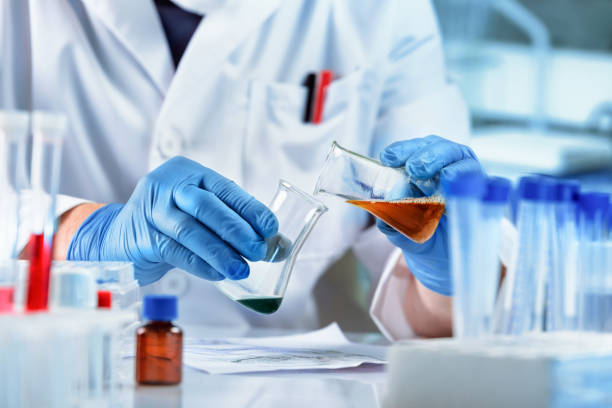
Scientist mixing chemical liquids in the chemistry lab. Researcher working whit fluids in flasks in the chemical laboratory
The modern global economy relies heavily on physical and chemical transformations to create everyday products. From clean hydrogen fuels and solid-state batteries to specialized eco-polymers and life-saving pharmaceuticals, industrial scale-up depends entirely on process optimization. Within the international scientific community, a vast amount of this pioneering progress is recorded, analyzed, and disseminated through the academic framework of Huaxue Gongcheng– the Chinese domain of Chemical Engineering.
As both a prestigious peer-reviewed journal (ISSN: 1005-9954) and a massive industrial sector, Huaxue Gongcheng serves as a primary driver for technological progress. Today, China’s rapid manufacturing evolution, paired with aggressive carbon-neutrality mandates, is pushing this discipline into a highly sophisticated era.
This article explores the core research themes, technological breakthroughs, and future trajectories of chemical engineering in China, highlighting how these advancements bridge lab-scale science and green manufacturing.
The Strategic Role of Huaxue Gongcheng in Academic Research
Academic literature acts as the ultimate bedrock of industrial safety and efficiency. Without rigorous validation, scaling up complex, high-pressure molecular reactions would be incredibly slow and hazardous. Since its historical inception, the journal Huaxue Gongcheng (Chemical Engineering) has committed itself to gathering and disseminating excellent research achievements.
The academic scope of the discipline spans several vital pillars:
- Process Thermodynamics and Multiphase Flow: Mathematical modeling of how gases, liquids, and solids interact under high thermal stress.
- Reaction Kinetics and Catalysis: Designing reactor conditions that accelerate molecular yields while suppressing unwanted, hazardous byproducts.
- Advanced Separation Engineering: Utilizing precision membranes, crystallization, and advanced absorption columns to purify compounds with minimal energy expenditure.
By standardizing these research methods, the publication provides global researchers, university students, and process engineers with access to validated datasets. This collective repository eliminates redundant experimentation and speeds up the deployment of next-generation chemical systems.
Driving Sustainable Technologies and Green Processing
China’s industrial sector is actively working toward its “dual carbon” goals—achieving peak carbon emissions by 2030 and full carbon neutrality by 2060. Consequently, the core focus of Huaxue Gongcheng has shifted entirely toward sustainable manufacturing and green engineering.
Carbon Capture, Utilization, and Storage (CCUS)
One of the most critical engineering frontiers is preventing greenhouse gases from escaping into the atmosphere. Chemical engineers are designing high-efficiency columns that capture carbon dioxide (CO2) directly from industrial exhaust plumes. Rather than storing this carbon underground, modern catalytic reactors are converting captured CO2 back into valuable synthetic natural gas, eco-friendly bioplastics, and liquid transport fuels.
Green Catalysis and Atom Economy
Traditional manufacturing processes often require high temperatures and intense pressures, consuming massive amounts of fossil energy. To bypass this, researchers are developing single-atom catalysts (SACs). By anchoring individual active metal atoms onto stable support materials, these catalysts achieve near-100% reaction selectivity, minimizing raw material waste and reducing the overall energy footprint of commercial plants.
Process Optimization: Bridging Lab Science and Industrial Scale-Up
Translating a successful molecular reaction from a tiny glass beaker in a university laboratory to a multi-ton industrial plant is the defining challenge of chemical engineering. A reaction that behaves perfectly at the microscale can become highly dangerous when scaled up to an industrial reactor due to heat and mass transfer limitations.

To resolve these scale-up bottlenecks, process innovators are moving away from traditional batch processing toward continuous-flow systems. The table below illustrates the structural shift defining modern process design:
| Performance Characteristic | Traditional Batch Operations | Modern Continuous-Flow Systems |
| Material Continuity | Discontinuous cycles requiring repeated filling, heating, and emptying | Uninterrupted material travel through automated processing lines |
| Thermal Dissipation | Slow and uneven inside massive tanks, increasing runaway risk | Near-instantaneous and highly uniform via high-surface-area micro-channels |
| Energy Consumption | High spikes due to cyclic heating and cooling of large vessels | Low and steady, utilizing integrated heat exchangers to recycle energy |
| Active Chemical Volatility | Massive volumes of hazardous reactants held under pressure at once | Minimal active chemical volumes contained within narrow micro-flow tubes |
By utilizing continuous-flow systems and microreactors, modern plants can safely run highly exothermic (heat-generating) reactions. The high surface-area-to-volume ratio of narrow flow channels ensures that sudden temperature spikes are dissipated instantly, completely engineering out the risk of industrial runaway reactions.
Digital Transformation: AI and Smart Manufacturing
The future of Huaxue Gongcheng is being built at the intersection of process technology, big data, and machine learning. Modern chemical plants are no longer operated purely through manual gauge monitoring; they are turning into intelligent, fully automated environments.
The modern smart factory utilizes a highly responsive optimization workflow:
- Continuous IoT Data Collection: Tens of thousands of smart sensors monitor real-time temperature, flow rates, and pressure profiles across the plant.
- High-Fidelity Virtual Replication: This data stream updates a “Digital Twin”—an exact virtual simulation of the physical processing plant operating in real time.
- Predictive Machine Learning: AI algorithms analyze live data against historical trends to detect micro-anomalies, predicting mechanical wear or product defects before they manifest.
- Automated System Optimization: The system automatically tunes control valves and heating elements, maximizing product yield with zero operational downtime.
This digital evolution ensures that modern processing plants consistently operate at peak thermodynamic efficiency, preventing accidental emissions and reducing human error.
Future Trends Shaping the Chemical Engineering Sector in China
As industrial demands continue to evolve, the integration of clean energy and advanced materials science will redefine the boundaries of Huaxue Gongcheng.
Industrial Reactor Electrification
To achieve true carbon neutrality, chemical facilities must stop burning natural gas for process heat. A major shift is underway to fully electrify industrial reactors, utilizing renewable solar, wind, and nuclear energy to power electrochemical cells directly. This substitution allows complex chemical syntheses to be driven with intense molecular precision and zero direct greenhouse gas emissions.
Circular Plastics and Enzymatic Depolymerization
Traditional plastic recycling simply melts down waste materials, which degrades their molecular chains and yields lower-quality plastics. Chemical engineers are developing advanced depolymerization processes that use engineered bio-enzymes to break down plastic waste back into its raw, molecular monomers. These purified monomers can then be resynthesized into brand-new polymers of identical quality to virgin materials, establishing a truly infinite circular plastics economy.
Conclusion
The discipline of Huaxue Gongcheng serves as a primary engine for human material progress and environmental stewardship. By advancing green catalysis, scaling up continuous-flow technologies, driving digital plant transformations, and enforcing strict circular-economy principles, chemical engineering proves that industrial productivity and environmental preservation can successfully coexist. As these innovations continue to mature, the global scientific community gains access to the essential blueprints required to build a cleaner, safer, and more sustainable world.
Are you looking to stay at the absolute forefront of modern process technology and scholarly breakthroughs? Explore our extensive library of peer-reviewed literature, connect with leading industrial experts, and join the global movement toward chemical engineering excellence!
Frequently Asked Questions (FAQs)
1. What does the term “Huaxue Gongcheng” mean?
“Huaxue Gongcheng” is the direct Chinese translation for Chemical Engineering. It refers to the academic discipline, research literature, and industrial application of processes that transform raw molecular feedstocks into valuable physical products.
2. Is Huaxue Gongcheng/Chemical Engineering an internationally recognized research journal?
Yes. Huaxue Gongcheng/Chemical Engineering (ISSN: 1005-9954) is a long-running, peer-reviewed academic journal based in China. It is indexed in major global databases, including Scopus, and focuses on disseminating high-quality research in general chemical engineering and process technologies.
3. How does continuous-flow processing improve chemical safety?
Continuous-flow systems move raw materials through automated, micro-sized channels rather than large batch tanks. This configuration reduces the active volume of hazardous chemicals present in the reactor at any given second and provides near-instantaneous heat dissipation, preventing dangerous runaway thermal reactions.
4. What is Process Intensification (PI) in modern manufacturing?
Process Intensification is a design approach aimed at making industrial equipment significantly smaller, cleaner, and more efficient. It often involves combining multiple chemical processing steps—such as chemical reactions and structural separations—into a single, highly integrated unit, reducing both energy consumption and physical land footprint.
5. How does chemical engineering contribute to the global hydrogen economy?
Chemical engineers are essential to the hydrogen transition. They design high-efficiency water electrolyzers to generate green hydrogen, engineer advanced solid-state storage materials, and create high-durability proton-exchange membranes for fuel cells.
6. What is a “Digital Twin” in a chemical processing facility?
A Digital Twin is a real-time, virtual replica of an active chemical plant. Connected via IoT sensors and analyzed by machine learning models, the virtual twin allows operators to safely test pressure changes, predict when mechanical equipment will wear out, and optimize energy efficiency without interrupting physical production lines.
Internal and External Linking Recommendations
- Internal Link Target: Integrate links to the website’s submission page or editorial guidelines using anchor texts like “peer-reviewed research journal” or “submit a manuscript to Huaxue Gongcheng.”
- External Link Target: Link out to major academic index repositories or authoritative engineering frameworks using highly descriptive anchors, such as “Scopus indexing data for chemical engineering journals” or “the principles of green chemistry and atom economy.”
About the Author