Scrub silhouette describes the overall shape created by a garment, including how closely it follows the body, where it adds volume, and how the fabric narrows or widens through the garment. In medical workwear, silhouette affects more than appearance. It can change how easily a healthcare professional walks, bends, reaches, sits, and moves throughout a shift.
The right silhouette depends on the garment, body proportions, fabric behavior, and workplace demands. A tapered pant can create a streamlined appearance while concentrating fabric closer to the lower leg. A wider pant provides more room through the leg but introduces more fabric movement. Similarly, a shaped scrub top can create definition while a relaxed top provides additional ease.
When evaluating Elite medical scrubs, it is useful to consider silhouette as part of the complete fit rather than treating it as a purely stylistic choice. Different silhouettes can support different preferences while still providing a professional healthcare uniform.
Quick Answer
Scrub silhouettes affect fit and movement by determining how much fabric is available around the shoulders, torso, hips, thighs, knees, and lower legs.
Key considerations include:
- Fitted silhouettes: Follow the body’s contours more closely and require accurate sizing.
- Relaxed silhouettes: Provide additional room and can feel less restrictive.
- Tapered pants: Narrow toward the ankle and create a streamlined leg shape.
- Joggers: Concentrate fabric toward the lower leg and typically provide a contemporary silhouette.
- Straight-leg pants: Maintain relatively consistent width through the leg.
- Wide-leg pants: Provide more room and fabric movement through the leg.
- Flare pants: Become wider toward the hem and create additional lower-leg volume.
- Shaped tops: Use seams or panels to create more defined contours.
- Layered silhouettes: Need enough room to accommodate underscrubs or jackets.
- Fabric behavior matters: Stretch, drape, and weight can change how the same silhouette feels.
There is no universally ideal scrub silhouette. The appropriate choice depends on body proportions, movement requirements, comfort preferences, garment construction, and workplace expectations.
What Is a Scrub Silhouette?
A garment’s silhouette is its overall visible shape.
In medical scrubs, silhouette can describe:
- How close a top sits to the torso
- How much room exists around the chest and waist
- How pants fit through the hips and thighs
- Whether the leg narrows or widens
- Where a garment adds or removes volume
- How the garment appears while standing and moving
Silhouette is different from size.
Two scrub tops can both be the same size while having very different silhouettes.
One may be:
- Relaxed
- Straight
- Shaped
Another may have:
- Princess seams
- A defined waist
- An asymmetrical hem
- Additional torso ease
Similarly, two pairs of pants can have the same waist measurement while producing very different leg shapes.
Why Does Scrub Silhouette Matter in Healthcare Workwear?
Healthcare professionals rarely wear scrubs only for appearance.
The garments must accommodate repeated movement.
Depending on the role, a workday can involve:
- Walking
- Standing
- Sitting
- Bending
- Reaching
- Turning
- Squatting
- Moving between clinical areas
Silhouette determines how much fabric is available for these movements and where that fabric is positioned.
Silhouette Can Affect Mobility
A garment that closely follows the body may require adequate stretch and precise sizing.
A relaxed silhouette provides more room but may introduce additional fabric.
The objective is not to maximize or minimize fabric.
The objective is to provide appropriate room where movement requires it.
How Does a Fitted Scrub Silhouette Affect Movement?
A fitted garment follows the body’s contours more closely.
This can create a defined and streamlined appearance.
However, accurate sizing becomes particularly important.

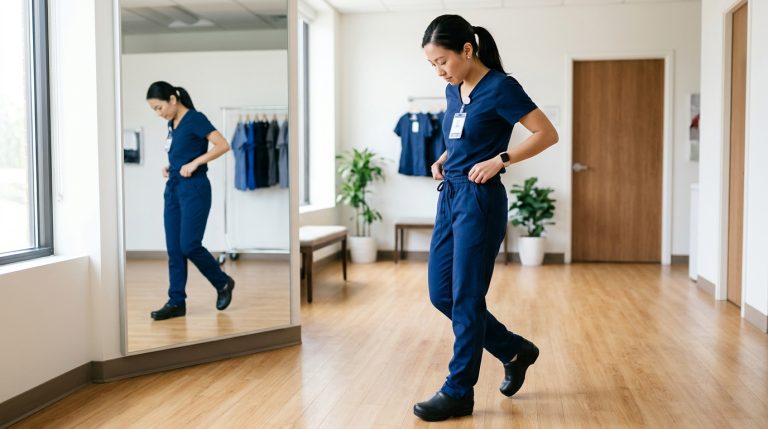
ALT: Healthcare professional testing fitted scrub top movement
A fitted scrub top that is too small can create:
- Shoulder tension
- Chest pulling
- Restricted arm movement
- Pocket distortion
- Fabric bunching
A fitted pant that is too narrow through the hips or thighs can create similar issues.
Stretch Does Not Replace Correct Fit
Stretch can improve mobility, but it should not compensate for a garment that is fundamentally too small.
A well-designed fitted scrub should provide enough room for normal movement while maintaining its intended silhouette.
What Is a Relaxed Scrub Silhouette?
A relaxed silhouette provides additional room around the body.
It can be useful for healthcare professionals who prefer:
- Greater torso room
- Less body-contouring
- More freedom of movement
- A softer workwear appearance
A relaxed garment can still look professional.
The main concern is proportion.
Too much excess fabric can create a shapeless appearance or interfere with movement.
How to Keep a Relaxed Silhouette Polished
Look for:
- Correct shoulder placement
- Controlled hem length
- Appropriate sleeve volume
- Balanced proportions
- Fabric with suitable drape
A relaxed top should look intentionally designed rather than simply oversized.
How Do Shaped Scrub Tops Affect Fit?
Shaped tops use seams, panels, darts, or other construction techniques to create more definition.
Common design elements include:
- Princess seams
- Back darts
- Shaped side seams
- Curved hems
- Panel construction
These details can influence how fabric sits around the torso.
Shaping Can Improve Visual Definition
A shaped scrub top can create a more tailored appearance without necessarily becoming tight.
The garment should still provide adequate room for:
- Breathing
- Reaching
- Bending
- Sitting
The ideal amount of shaping depends on the wearer and the specific garment pattern.
How Do V-Neck and Other Neckline Silhouettes Affect Appearance?
The neckline forms part of the upper-body silhouette.
A V-neck creates a vertical opening through the upper torso.
A round neckline produces a different visual shape.
A mock-wrap or shaped neckline may introduce additional angles and seam lines.
None is inherently more professional.
The important considerations are:
- Workplace appropriateness
- Comfort
- Garment stability
- Body proportions
- Layering compatibility
A neckline should remain secure and comfortable during normal movement.
How Do Sleeve Silhouettes Affect Mobility?
Sleeves determine how much fabric surrounds the upper arm.
A narrow sleeve can create a streamlined appearance but may become restrictive if there is insufficient room.
A relaxed sleeve provides more space but can introduce additional fabric.
Test Sleeve Mobility
When trying on a scrub top:
- Raise both arms.
- Reach forward.
- Cross the arms.
- Rotate the torso.
- Bend the elbows.
Watch for pulling around the:
- Shoulders
- Armholes
- Upper arms
- Upper back
The sleeve silhouette should support the movement required during work.
How Does Pant Silhouette Affect Fit?
Pant silhouette controls how fabric is distributed from the waist to the ankle.
Important areas include:
- Waist
- Rise
- Hips
- Thighs
- Knees
- Calves
- Ankles
A pant may fit properly at the waist but feel restrictive through the thighs.
Another may provide excellent thigh room but have excessive volume around the ankle.
Silhouette needs to be considered as a complete system.
What Is a Tapered Scrub Pant?
A tapered pant gradually narrows from the upper leg toward the ankle.
This produces a streamlined lower-body silhouette.
Tapered pants can provide:
- Controlled fabric volume
- A cleaner lower-leg profile
- A contemporary appearance
However, the wearer should check calf and ankle room.
What to Check With Tapered Pants
Try:
- Walking
- Sitting
- Bending
- Taking a long step
The fabric should not create excessive tension through the knees or calves.
What Is a Jogger Scrub Pant?
Joggers generally feature a more pronounced narrowing toward the lower leg and may include an elastic cuff.

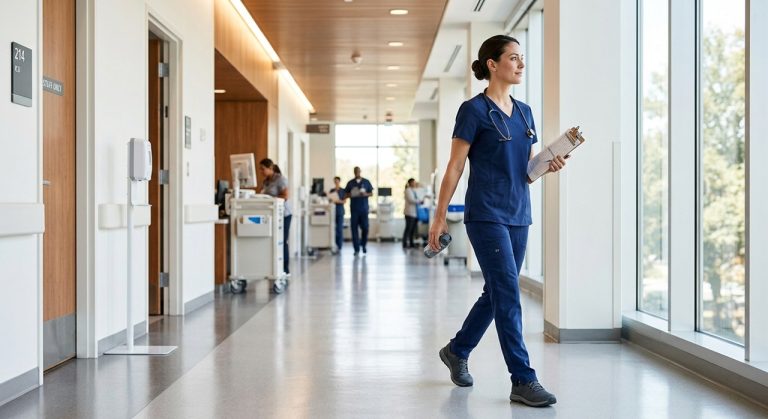
ALT: Healthcare professional wearing tapered jogger medical scrub pants
This creates a distinctly contemporary silhouette.
Joggers can appeal to professionals who prefer:
- A contained lower leg
- Less loose fabric around footwear
- A modern workwear appearance
The cuff should not create uncomfortable pressure around the ankle.
Jogger Fit Requires Attention to Multiple Areas
Check:
- Waistband
- Rise
- Hip room
- Thigh room
- Knee movement
- Calf fit
- Ankle comfort
A jogger should not be evaluated solely by how it looks from the front.
What Is a Straight-Leg Scrub Pant?
Straight-leg pants maintain a relatively consistent width through much of the lower leg.
They can create a traditional and versatile silhouette.
Potential advantages include:
- Consistent leg room
- Simple proportions
- Easy coordination with different scrub tops
- Less concentration of fabric around the ankle
Straight-leg pants can work well for healthcare professionals who prefer a classic workwear profile.
What Is a Wide-Leg Scrub Pant?
Wide-leg pants provide greater fabric volume through the leg.
They can be useful for wearers who prefer:
- More leg room
- Less close-fitting fabric
- Greater lower-body volume
However, additional fabric can change the way the garment moves.
Wide-Leg Pants Need Appropriate Length
A wide hem that is too long can:
- Contact footwear
- Drag against the floor
- Create excessive folds
- Affect walking
The inseam should therefore be considered alongside the silhouette.
What Is a Flare Scrub Pant?
Flare pants generally become wider below the knee.
This creates a distinctive lower-leg silhouette.
The additional hem volume can affect:
- Walking movement
- Footwear interaction
- Overall proportion
- Visual balance with the scrub top
Flare pants can create a polished appearance when the length and upper-leg fit are appropriate.
How Does Waistband Design Change Pant Silhouette?
The waistband forms the starting point for the pant silhouette.
Common options include:
- Full elastic
- Yoga waistband
- Drawstring
- Combination waistband
Each distributes pressure differently.
Yoga Waistbands
A broad yoga waistband can create a smoother transition around the waist.
Full Elastic Waistbands
Full elastic can provide flexible waist movement.
Drawstring Waistbands
Drawstrings can allow the wearer to adjust security.
The waistband should support the pant without becoming visually distracting or physically uncomfortable.
How Does Rise Affect Scrub Pant Silhouette?
Rise influences where the waistband sits in relation to the hips and torso.
A shorter rise may create a lower-sitting appearance.
A longer rise may provide more coverage around the waist.
The correct choice depends on:
- Torso length
- Body proportions
- Personal preference
- Workplace requirements
- Garment design
Test Rise While Sitting
Standing alone does not reveal the complete fit.
Sit down.
Lean forward.
Stand again.
The waistband should remain stable without excessive pressure or slipping.
How Does Fabric Drape Change a Scrub Silhouette?
Fabric drape describes how the material falls and moves.
Two garments with similar patterns can appear different when made from fabrics with different drape.
A fluid fabric may:
- Follow the garment’s contours softly
- Create more visible movement
- Form softer folds
A structured textile may:
- Hold firmer lines
- Maintain more shape
- Create a stronger visual silhouette
The best combination depends on the garment design.
Does Stretch Change the Appearance of Scrub Silhouettes?
Yes.
Stretch can allow fabric to move with the body while maintaining the intended shape.
It can be particularly useful in areas that experience repeated movement.
However, excessive tension can still occur if the garment is too small.
Stretch should therefore be considered alongside:
- Size
- Pattern
- Fabric recovery
- Drape
- Body proportions
What Is Fabric Recovery and Why Does It Matter?
Recovery describes how fabric behaves after being stretched.
This can influence the appearance of areas such as:
- Knees
- Elbows
- Hips
- Shoulders
- Waist
Healthcare professionals may repeatedly bend and reach throughout a shift.
After repeated movement, the garment should continue to maintain a reasonably consistent silhouette.
How Do Body Proportions Affect Scrub Silhouette?
A silhouette is not experienced identically by every wearer.
Important differences include:
- Shoulder width
- Torso length
- Bust or chest proportion
- Waist placement
- Hip width
- Thigh proportion
- Leg length
A garment that appears balanced on one person may sit differently on another.
Use Measurements Rather Than Model Appearance
Product photography can demonstrate a garment’s intended silhouette.
It cannot predict exact fit for every body.
When choosing a scrub garment, compare personal measurements with the relevant size chart whenever possible.
How Does Top and Pant Proportion Affect the Overall Uniform?
A scrub uniform is a complete visual system.
The relationship between the top and pants can change perceived proportions.
For example:
- A longer relaxed top can visually reduce the apparent length of the legs.
- A shorter top can emphasize the waistband and upper leg.
- A wide-leg pant can create more lower-body volume.
- A tapered pant can create a narrower lower-body line.
These are visual effects, not rules about which proportions are better.
The goal is to select combinations that feel appropriate and comfortable for the wearer.
How Can a Healthcare Professional Create a Balanced Scrub Silhouette?
Start by considering the dominant feature of the outfit.
If the top has:
- Strong shaping
- Contrast details
- Asymmetry
- Multiple seam lines
a simpler pant silhouette can provide visual balance.
If the top is relatively simple, a distinctive pant silhouette can introduce variation.
This approach prevents every garment from competing visually.
Does a Scrub Silhouette Affect Professional Appearance?
Yes, but professional appearance is not limited to a specific silhouette.
A professional scrub uniform generally benefits from:
- Appropriate fit
- Clean garment lines
- Controlled proportions
- Workplace-appropriate color
- Well-maintained fabric
- Practical construction
A jogger can look professional.
A straight-leg pant can look professional.
A wide-leg pant can also look professional.
The difference is how the garment fits and whether the silhouette is appropriate for the work environment.
Can Stylish Scrub Silhouettes Still Be Functional?
Yes.
Modern healthcare workwear can incorporate:
- Tapered legs
- Jogger cuffs
- Shaped tops
- Contrast panels
- Asymmetrical details
- Contemporary necklines
These design features do not automatically make a garment less functional.
The important question is whether the design allows the wearer to perform normal work movements.
How Should Scrub Silhouettes Be Tested for Movement?
A dynamic fitting test is more useful than simply standing in front of a mirror.

ALT: Healthcare professional testing scrub fit through movement
Test the Top
Perform:
- Forward reach
- Overhead reach
- Arm crossing
- Torso rotation
Test the Pants
Perform:
- Walking
- Sitting
- Taking a long step
- Knee bending
- Shallow squatting
Check the Garment After Movement
Look for:
- Excessive pulling
- Riding upward
- Waistband movement
- Fabric bunching
- Pocket distortion
If the garment needs constant adjustment, the silhouette or size may not be appropriate.
How Does Layering Change Scrub Silhouette?
A scrub top rarely exists in isolation.
Healthcare professionals may wear:
- Underscrubs
- Base layers
- Scrub jackets
- Other workplace-approved layers
Each layer increases the amount of space needed around the body.
Test the Complete Outfit
If an underscrub is normally worn, wear it when evaluating the top.
If a jacket is part of the normal uniform, try the jacket over the scrub top.
The final silhouette should remain comfortable and coordinated.
How Do Scrub Jackets Affect the Overall Silhouette?
A jacket adds another structural layer.
A well-fitting jacket can create:
- Additional definition
- A more structured outer layer
- A cohesive uniform appearance
However, it should not compress the scrub top underneath.
The women’s scrub jackets category can be useful when considering how an outer layer fits into a complete women’s scrub wardrobe.
How Should Healthcare Professionals Choose Scrub Silhouettes for Long Shifts?
Long shifts increase the importance of comfort.
A silhouette that feels acceptable for a few minutes may become distracting after several hours.
Consider:
- Waistband pressure
- Shoulder movement
- Fabric weight
- Leg room
- Garment length
- Pocket placement
- Layering
The goal is a silhouette that remains functional after repeated movement.
Which Scrub Silhouette Works Best for Active Jobs?
There is no universal answer.
Highly active roles may benefit from silhouettes that provide:
- Adequate hip and thigh room
- Useful stretch
- Stable waistbands
- Controlled lower-leg volume
- Appropriate garment length
The best silhouette depends on the movements actually performed.
A jogger may suit one professional, while a straight or wide-leg pant may work better for another.
How Should Healthcare Professionals Choose Scrub Silhouettes for Seated Work?
Professionals who spend substantial time sitting should pay particular attention to:
- Pant rise
- Waistband pressure
- Hip room
- Thigh room
- Top length
A garment should remain comfortable when the hips and knees are flexed.
The waistband should not become excessively tight when sitting.
How Should Petite Healthcare Professionals Choose Scrub Silhouettes?
Petite wearers may find that garment proportions are as important as overall size.
Potential considerations include:
- Shorter inseam options
- Top length
- Sleeve length
- Pocket position
- Knee placement
A garment that is correctly sized around the waist can still have excessive length elsewhere.
Where available, petite-specific lengths can help address these differences.
How Should Tall Healthcare Professionals Choose Scrub Silhouettes?
Tall wearers may need additional length through:
- Sleeves
- Torso
- Inseam
A pant that is wide enough through the hips but too short in the inseam will not maintain the intended silhouette.
Where available, tall lengths can help preserve the garment’s proportions.
How Do Pockets Interact With Silhouette?
Pockets add both volume and weight.
A top with large pockets may appear different from a minimalist top.
A cargo pant may create more visual volume around the thighs than a simple five-pocket design.
Consider Actual Storage Needs
A practical pocket configuration should support what the wearer actually carries.
Overloading pockets can distort even a well-designed silhouette.
How Does Color Interact With Silhouette?
Color can affect how garment proportions are perceived.
Contrast between a top and pant can visually separate the body into different sections.
A single-color uniform can create a more continuous visual line.
Neither approach is inherently more professional.
Workplace color requirements should come first.
How Does Pattern Construction Affect Silhouette?
Pattern construction determines how flat pieces of fabric become a three-dimensional garment.
Details such as:
- Darts
- Panels
- Seams
- Gussets
- Side vents
- Curved hems
can influence movement and shape.
A thoughtfully designed pattern can provide room in one area while maintaining a controlled silhouette elsewhere.
What Makes a Scrub Silhouette Look Intentional?
An intentional silhouette generally has consistent proportions.
For example:
- Shoulder seams sit appropriately.
- The torso has controlled volume.
- The hem falls at an appropriate position.
- Pant legs follow the intended shape.
- The waistband stays in place.
- Fabric does not bunch excessively.
The result does not need to be fitted.
It simply needs to look like the garment was selected and sized deliberately.
A Practical Scrub Silhouette Comparison
| Silhouette | Main Shape | Potential Strength | What to Check |
| Fitted top | Close to torso | Defined appearance | Chest and shoulder mobility |
| Relaxed top | More torso room | Ease of movement | Excess fabric |
| Shaped top | Contoured through seams | Tailored appearance | Seam placement |
| Jogger pant | Narrow lower leg | Controlled ankle area | Calf and cuff comfort |
| Tapered pant | Gradually narrows | Streamlined shape | Knee and calf room |
| Straight pant | Consistent leg width | Versatile shape | Overall proportion |
| Wide-leg pant | Greater leg volume | More lower-body room | Length and fabric volume |
| Flare pant | Wider below knee | Distinctive lower-leg shape | Hem length |
A Practical Scrub Fit Checklist
Before purchasing a new scrub silhouette, check:
Top
- Do the shoulders fit correctly?
- Is there enough chest and torso room?
- Can the arms move freely?
- Does the neckline remain stable?
- Is the top length appropriate?
Pants
- Is the waistband secure?
- Does the rise remain comfortable while sitting?
- Is there sufficient hip and thigh room?
- Can the knees bend comfortably?
- Does the lower leg have appropriate room?
- Is the inseam correct?
Overall Uniform
- Do the top and pants look proportionate together?
- Does the fabric drape naturally?
- Are pockets functional?
- Does layering create unnecessary bulk?
- Does the garment remain comfortable after movement?
Final Thoughts
Scrub silhouette is more than a style decision. It determines how fabric is distributed around the body and can influence fit, mobility, comfort, proportion, and professional appearance.
Fitted and relaxed tops provide different approaches to torso comfort. Jogger, tapered, straight, wide-leg, and flare pants distribute fabric differently through the lower body. Waistband construction, rise, fabric drape, stretch, and recovery further influence how each silhouette behaves during a working day.
For healthcare professionals evaluating Elite medical scrubs, the most useful approach is to consider the entire garment rather than selecting a silhouette based only on appearance. A well-chosen silhouette should support the movements required by the job while maintaining an appropriate professional appearance.
There is no single silhouette that works for every healthcare professional.
The right choice is the one that provides appropriate room, stable fit, practical movement, useful functionality, and a proportion that feels intentional throughout the workday.
Frequently Asked Questions
What is a scrub silhouette?
A scrub silhouette is the overall shape created by a scrub garment. It describes how closely the clothing follows the body, where it provides additional room, and how the garment narrows, widens, or maintains its shape.
Do scrub silhouettes affect comfort?
Yes. Silhouette determines where fabric is distributed around the body. A garment that is too narrow can restrict movement, while excessive fabric can create bulk or interference. Comfort depends on silhouette, sizing, fabric, and garment construction together.
Are jogger scrubs more comfortable than straight-leg scrubs?
Not necessarily. Joggers and straight-leg pants distribute fabric differently. Comfort depends on the waistband, rise, hip and thigh fit, calf room, fabric stretch, and personal preference.
What scrub silhouette is best for active healthcare professionals?
There is no universal best silhouette. Active professionals should look for adequate room through areas that move frequently, useful stretch, a stable waistband, and a practical leg shape that does not interfere with movement.
How should scrub pants fit around the thighs?
Scrub pants should provide enough room for walking, sitting, bending, and squatting without severe horizontal pulling. The pants should not be excessively loose either, because unnecessary fabric can affect the intended silhouette.
Can a relaxed scrub top still look professional?
Yes. A relaxed top can look polished when the shoulders, sleeves, length, and overall proportions are intentional. Professional appearance does not require a close-fitting silhouette.
About the Author