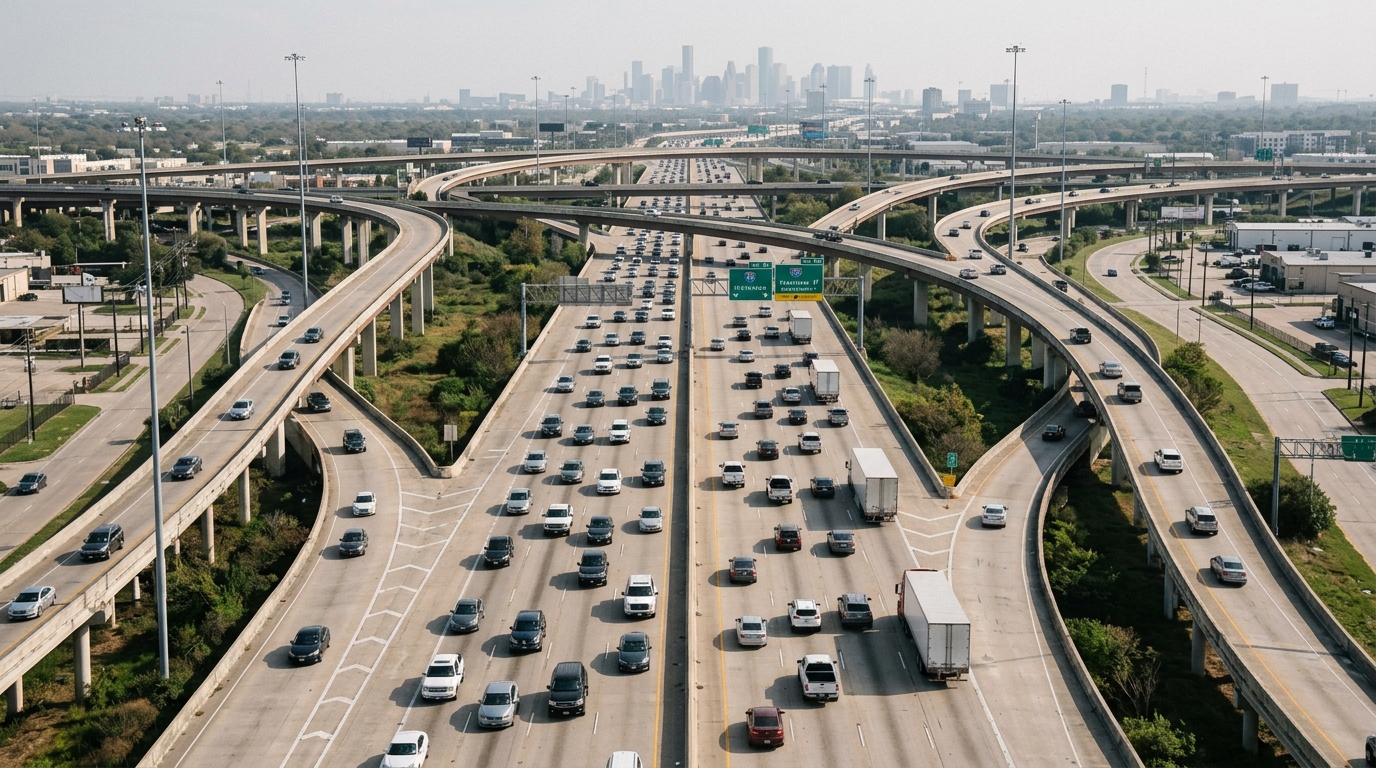
If you drive around Houston regularly, you probably know that some freeway connections demand more attention than others. A trip that seems straightforward on a map can involve several lanes of merging traffic, short distances between exits, and vehicles trying to reach different parts of the city at the same time.
The connection between Interstate 45 and Loop 610 is one of the areas where those challenges meet.
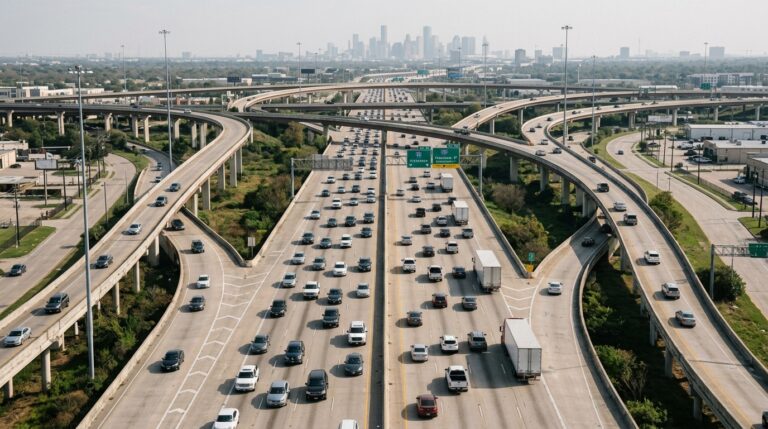
I-45 carries traffic through Houston from the Gulf Coast toward downtown and northern communities. Loop 610 circles the city and connects drivers with other major highways, employment centers, industrial areas, and neighborhoods. Where these roads meet, drivers may need to change lanes, enter or leave the freeway, and respond to traffic slowing ahead.
These conditions can create opportunities for collisions, particularly when drivers follow too closely, misjudge a gap, or make a last-second lane change.
But there is an important distinction between a complicated interchange and a statistically verified crash hotspot. The strongest way to understand roadway risks is to examine crash data for a defined location and period, then consider how the roadway is designed and used.
This guide looks at documented safety concerns around Houston’s I-45 and Loop 610 connections, explains the driving conditions that can contribute to crashes, and offers practical advice for motorists who use these routes.
What Do Crash Studies Tell Us About I-45 And Loop 610?
Texas transportation studies have identified several freeway interchanges in Houston as locations with concentrated crash activity.
A TxDOT freight-corridor study used crash records from 2013 through 2017 to examine general traffic and commercial vehicle crashes across major freight routes. Its analysis identified several interchange areas with high crash concentrations, including I-610 and I-45 South. The study used crash heat maps to identify locations that warranted closer attention.
The study is useful because it examines actual reported crashes rather than relying solely on traffic volume or anecdotal accounts. However, its data is historical and should not be treated as a current annual crash count.
You can review the TxDOT Houston freight study executive summary for the study’s crash-analysis approach and findings.
A separate TxDOT Gulf Freeway planning study examined I-45 South between I-69 and Spur 5 using crash data from 2014 through 2018. The study reported nearly 10,400 crashes across its defined corridor during that five-year period. It also calculated a crash rate of 419 crashes per 100 million vehicle miles traveled for the segment between I-69 and Spur 5, compared with a statewide urban-interstate average of 140 for the study’s comparison period.
That figure illustrates why crash rates matter: they account for vehicle travel, allowing a more meaningful comparison than raw totals alone. The segment is broader than the I-45 and Loop 610 interchange itself, so the figure must not be represented as the interchange’s individual crash rate.
The original findings are available in TxDOT’s Gulf Freeway I-45 South Purpose and Need Report.
The takeaway: Official studies have documented significant crash activity along parts of I-45 South and at the I-45/Loop 610 connection. To determine current conditions at a particular ramp or roadway segment, drivers and researchers should consult more recent crash records with clearly defined location boundaries.
Why The I-45 And Loop 610 Connection Can Be Challenging
A major interchange is not simply a place where two highways cross. It is a series of connected traffic movements, each with its own entry points, exit points, and merging areas.
Several conditions can make these connections demanding for drivers.
1. Merging traffic competing for space
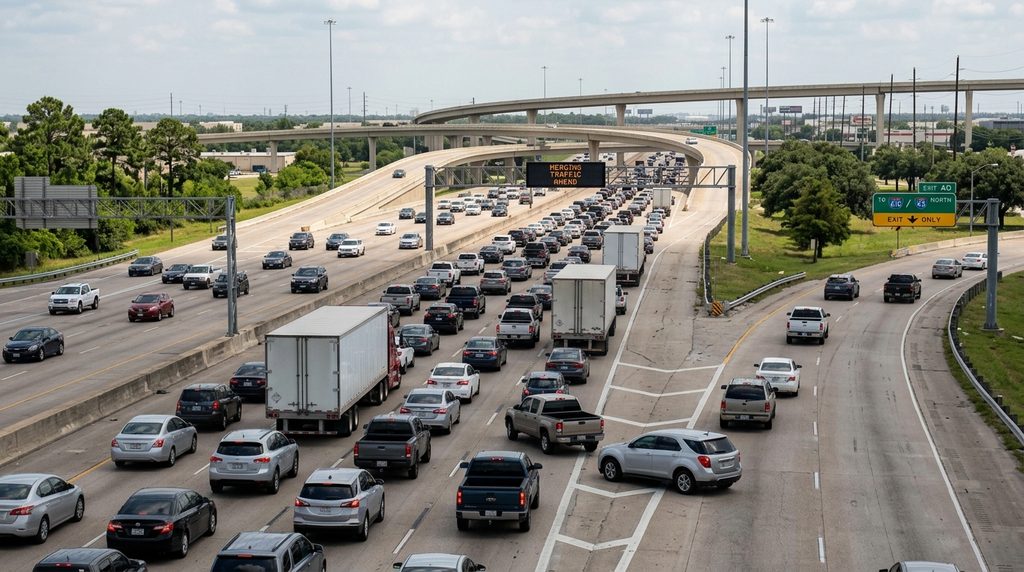
Vehicles entering I-45 or Loop 610 need a safe gap in moving traffic. At the same time, drivers already on the freeway may be trying to maintain speed or move into another lane.
A problem can develop when someone merges without enough space, accelerates too slowly for the available gap, or brakes unexpectedly while entering the freeway.
Drivers should check traffic early, signal their intentions, and avoid assuming another motorist will automatically make room.
2. Short distances between exits
When exits are close together, drivers may realize too late that they need another lane.
That can lead to abrupt lane changes, hard braking, or attempts to cross several lanes at once.
Knowing your route in advance can help. If you miss an exit, continue to the next safe route rather than making a sudden maneuver.
3. Traffic moving at different speeds
A freeway may have one lane moving freely while another is slowing near a ramp or bottleneck.
A driver approaching the slower lane at high speed may have little time to react. Rear-end crashes and chain-reaction collisions can follow.
Watching traffic several vehicles ahead, rather than focusing only on the car directly in front, can help you recognize slowdowns earlier.
4. Commercial truck movements
Houston’s major freeways carry substantial freight traffic. Trucks may need additional room to change lanes and may have larger blind spots than passenger vehicles.
At a busy interchange, a truck may be navigating a curve or preparing for an exit while nearby vehicles attempt to pass or merge.
Give commercial vehicles space, avoid lingering beside them, and do not cut closely in front of a truck.
5. Construction and changing lane layouts
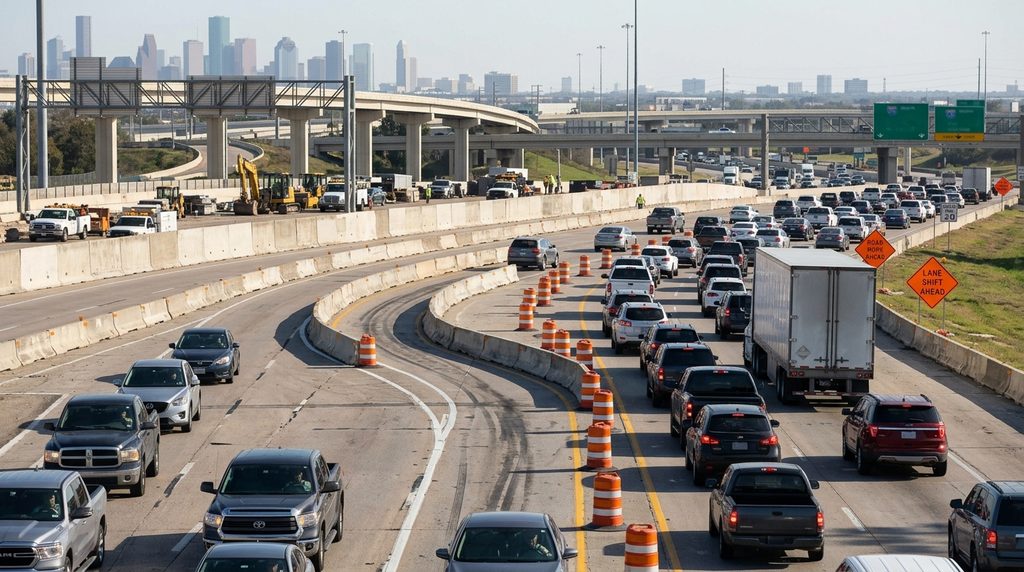
Roadwork can change familiar driving patterns through lane closures, temporary barriers, shifted traffic lanes, and altered ramp access.
A route that usually feels predictable may become more demanding when the layout changes.
Follow temporary signs, reduce speed when conditions require it, and leave additional room to react.
What Types Of Accidents Occur Around Freeway Interchanges?
Different traffic movements create different collision risks. Understanding the type of crash can help explain what investigators may need to examine afterward.
Rear-end collisions
Rear-end crashes may occur when traffic slows suddenly and a following driver cannot stop in time.
Possible contributing factors include distraction, following too closely, excessive speed for the conditions, or late reactions near an exit.
A rear-end collision does not automatically resolve every question about responsibility. Investigators may need to consider the surrounding traffic, vehicle movements, and other relevant evidence.
Sideswipe and lane-change crashes
A sideswipe can occur when two vehicles attempt to occupy the same lane or space during a lane change.
At an interchange, one driver may be moving toward an exit while another is merging into the same lane.
Photos, vehicle damage, witness accounts, and available video may help establish what happened.
Multi-vehicle collisions
When traffic is dense, one crash can trigger additional impacts.
For example, a vehicle brakes sharply near a ramp, the driver behind cannot stop, and another vehicle strikes the vehicles ahead.
These incidents may involve several different movements, so it is important to distinguish the initial impact from later collisions when reviewing the evidence.
Truck-related crashes
Commercial truck collisions can result in substantial damage because of differences in vehicle size and weight.
Depending on the circumstances, relevant issues may include following distance, lane changes, braking, vehicle maintenance, cargo securement, and the conduct of other road users.
The Federal Motor Carrier Safety Administration’s safety resources provide information about commercial motor vehicle safety and applicable federal requirements.
Single-vehicle crashes
A driver may lose control or strike a barrier without hitting another moving vehicle.
Road conditions, speed, visibility, vehicle condition, and driver actions may all be relevant to the investigation. The type of collision alone does not establish its cause.
How To Interpret Accident Statistics Without Drawing The Wrong Conclusion
A location with many crashes is not necessarily the location with the highest risk per mile traveled. A very busy interchange may record a high number of incidents partly because so many vehicles use it.
This is why transportation studies often examine more than raw totals.
| Measure | What it tells you |
| Total crashes | How many reported collisions occurred during the defined period. |
| Injury and fatal crashes | How severe the reported consequences were. |
| Crash rate | How frequently crashes occurred relative to a measure of vehicle travel. |
| Commercial vehicle involvement | Whether trucks or other commercial vehicles were involved in reported collisions. |
| Location boundaries | Whether the analysis covers main lanes, ramps, frontage roads, or a broader corridor. |
The period matters, too. A report based on 2013–2017 data can identify a historical safety concern, but it cannot establish today’s exact crash total.
For updated information, TxDOT’s Crash Data Analysis and Statistics page provides annual summaries, crash records information, and tools for examining publicly available data.
Which Conditions Should Drivers Watch For?
You cannot control every vehicle around you, but you can recognize conditions that call for extra attention.
Congestion near ramps
When traffic backs up near an exit or entrance, leave enough room to brake gradually. Avoid following so closely that you have to react at the last second.
Vehicles changing lanes late
Watch for drivers who move toward exits at the last moment or cross lane markings abruptly. Do not compete for the same space. Maintaining a safe gap is more important than protecting a position in traffic.
Rain and reduced visibility
Wet pavement can affect braking and handling. Heavy rain may also make lane markings harder to see.
Reduce speed appropriately, increase following distance, and avoid sudden steering or braking movements.
Distracted driving
Checking a phone or navigation screen can take your attention away from rapidly changing traffic.
Set navigation before driving, keep your eyes on the road, and pull over safely if you need to change a route.
Work zones
Temporary barriers and lane shifts can change the available space with little room for correction.
Follow posted speed limits and signs, and be prepared for queues beyond a visible work area.
What To Do After An Accident Near I-45 And Loop 610
A collision at a busy interchange can be especially stressful because traffic may still be moving around the vehicles. You may be concerned about your passengers, the condition of your car, and whether you can safely get out of the roadway.
Start with safety, not with trying to determine who was responsible.
1. Get to a safe location if possible
If you can safely move away from active traffic, do so. Call 911 if someone is injured or emergency assistance is needed.
Do not risk another collision to retrieve belongings or take photographs.
2. Get medical attention
Some injuries may not be obvious immediately after an accident. Neck pain, back pain, headaches, and other symptoms can become more noticeable later.
Seek appropriate medical care and follow your healthcare professional’s recommendations.
3. Exchange information
When it is safe, collect the other driver’s contact information, insurance details, and vehicle information.
If a commercial truck is involved, note the company and vehicle identification information when available.
4. Document the scene safely
If you can do so without entering traffic or creating another hazard, photograph:
- Vehicle damage.
- The positions of the vehicles.
- Lane markings and nearby signs.
- Road and weather conditions.
- Visible debris or other relevant physical evidence.
Do not stand in a travel lane or walk along a dangerous shoulder to obtain a photograph.
5. Preserve records
Keep the crash report information, medical bills, treatment records, repair estimates, receipts, photographs, and insurance correspondence.
The Texas Department of Insurance’s guide to what to do after a wreck explains how to collect information, document damage, and retain useful records.
Why Evidence Matters More Than The Name Of The Road
Knowing that an interchange has appeared in a crash study does not establish why an individual collision occurred.
A specific injury claim needs evidence about the particular event.
Photographs and video may show vehicle positions, damage, lane markings, and traffic conditions.
Witness accounts may help explain whether a vehicle merged, stopped, or changed lanes before the impact.
Police reports may contain observations and information about the people involved.
Commercial vehicle records may be relevant when a truck or company vehicle is involved.
Medical records help document injuries, treatment, and recovery.
Some evidence may be time-sensitive. Video footage can be overwritten, and physical conditions at a crash scene can change quickly.
Preserve relevant information when possible, and avoid assuming that a general crash ranking proves fault in a particular case.
How Texas Law Handles Shared Responsibility
Texas follows a modified comparative responsibility system under Chapter 33 of the Texas Civil Practice and Remedies Code.
In applicable injury claims, recoverable damages may be reduced according to the claimant’s percentage of responsibility. Under Section 33.001, a claimant who is more than 50% responsible cannot recover damages in an action governed by that provision.
A driver’s presence in a collision does not automatically establish that the driver shares responsibility. The evidence and applicable law matter.
You can review the official Texas proportionate responsibility statute for the governing rules.
When A Houston Accident Lawyer May Help
Some collisions result in limited vehicle damage and straightforward insurance claims. Others involve serious injuries, disputed fault, several vehicles, or commercial trucks.
Legal guidance may be worth considering when:
- You have serious or continuing injuries.
- The insurer disputes how the collision happened.
- Multiple drivers or businesses may be involved.
- A commercial truck was involved.
- Your ability to work has been affected.
- A settlement offer arrives before the full impact of your injuries is understood.
A Houston accident lawyer may help explain the claims process, review available evidence, and discuss options under Texas law.
For collisions involving commercial trucks, Thompson Law also provides information through its Houston truck accident lawyers page.
Not every accident requires legal representation. The goal is to understand your options and make an informed decision based on your own circumstances.

How To Check Crash Data For I-45 And Loop 610
If you want to investigate a particular section of the interchange, start with the official data rather than relying only on a general list of dangerous Houston roads.
- Visit TxDOT’s crash data and statistics page.
- Use the available public crash data tools or annual reports.
- Define the exact interchange, ramps, and roadway sections you want to examine.
- Choose a clear reporting period.
- Check whether the figures cover all crashes or only certain crash types.
- Compare locations using consistent boundaries and time periods.
For additional context, review TxDOT’s Gulf Freeway I-45 South planning report and its Houston freight-corridor study.
Together, these resources help explain why I-45 and Loop 610 connections deserve attention while also making clear that historical findings should not be mistaken for a current, continuously updated ranking.
Frequently Asked Questions
1. Is the I-45 and Loop 610 interchange a documented crash hotspot?
TxDOT studies have identified I-45 South and the I-45/Loop 610 interchange among locations with concentrated crash activity. However, the available studies use defined historical periods and roadway boundaries. A current ranking requires more recent data for the specific interchange.
2. Why do accidents happen near I-45 and Loop 610?
Potential contributing conditions include heavy traffic, merging movements, sudden slowdowns, late lane changes, commercial vehicle traffic, distraction, and changing road layouts. The cause of an individual collision depends on its specific circumstances.
3. Are truck accidents more dangerous around freeway interchanges?
Commercial trucks have different braking characteristics, larger blind spots, and greater mass than passenger vehicles. These factors can affect collision severity, but the outcome depends on the circumstances of the crash.
4. What should I do after a crash near I-45 and Loop 610?
Prioritize safety, call for emergency assistance when needed, seek medical care, exchange information when safe, document the scene if possible, and retain medical, repair, and insurance records.
5. Can I recover compensation if I was partly responsible for a Houston interchange crash?
Possibly. Texas law may reduce recoverable damages according to a claimant’s percentage of responsibility. Under the general rule in Section 33.001, a claimant found more than 50% responsible cannot recover damages in an action governed by that provision. The outcome depends on the facts and applicable law.
Final Thoughts
The I-45 and Loop 610 connection brings together several of Houston’s busiest traffic movements. Merging vehicles, commercial trucks, lane changes, and congestion can make these roadways demanding to navigate.
Official transportation studies have documented crash concentrations around I-45 South and the I-45/Loop 610 interchange. Those findings help explain why interchange safety deserves attention, but they do not replace current, location-specific data or establish the cause of an individual accident.
For drivers, the practical lessons are straightforward: leave enough room to react, plan exits early, avoid abrupt lane changes, and adjust to traffic and weather conditions.
If a collision happens, put safety and medical care first, preserve the evidence you can safely collect, and keep your records organized.
For local information, visit the Thompson Law Houston profile.
About the Author