After an accident in Phoenix, it is normal to wonder whether you really need a lawyer.
Some claims are simple. No one is injured, property damage is minor, fault is clear, and insurance handles the repair without much conflict. Other claims start simple and become complicated quickly. Pain gets worse. Medical bills arrive. The insurance company asks for a recorded statement. A crash report is delayed. The other driver blames you. Camera footage may disappear. A settlement offer arrives before treatment is complete.
The question is not only, “Was I in an accident?” The better question is, “Has my claim reached a tipping point where I should get legal guidance before making the next decision?”
This guide explains when hiring a Phoenix personal injury lawyer may be useful, what warning signs to watch for, what records to organize, and how Arizona timing rules may affect the claim.
Quick Answer
You should consider hiring a Phoenix personal injury lawyer when you were injured, needed medical care, missed work, face disputed fault, are being blamed by an insurance company, received a low settlement offer, were asked for a recorded statement or broad medical authorization, were hit by an uninsured or hit-and-run driver, were involved in a crash with a rideshare, delivery, commercial, or government vehicle, or are unsure what Arizona deadlines apply.
If your accident happened in Phoenix and the claim involves injuries, insurance pressure, missing evidence, or settlement questions, speaking with phoenix personal injury lawyers may help you understand what records matter and what steps may protect the claim. You can also use the Thompson Law Phoenix profile as a local starting point for map access, profile details, and contact options.
Key Takeaways
- You do not automatically need a lawyer for every minor accident.
- Legal help becomes more important when medical care, lost wages, disputed fault, missing evidence, or insurance pressure are involved.
- Phoenix claims may require quick evidence preservation because crash scenes, business cameras, dashcam footage, and witness information can disappear.
- Be careful before giving recorded statements, signing broad medical authorizations, or accepting a settlement release.
- Arizona injury claims may involve a general two-year deadline, shorter public-entity rules, and comparative-fault disputes.
- A useful first consultation is easier when you have report numbers, photos, medical records, insurance letters, wage proof, camera notes, and a written timeline.
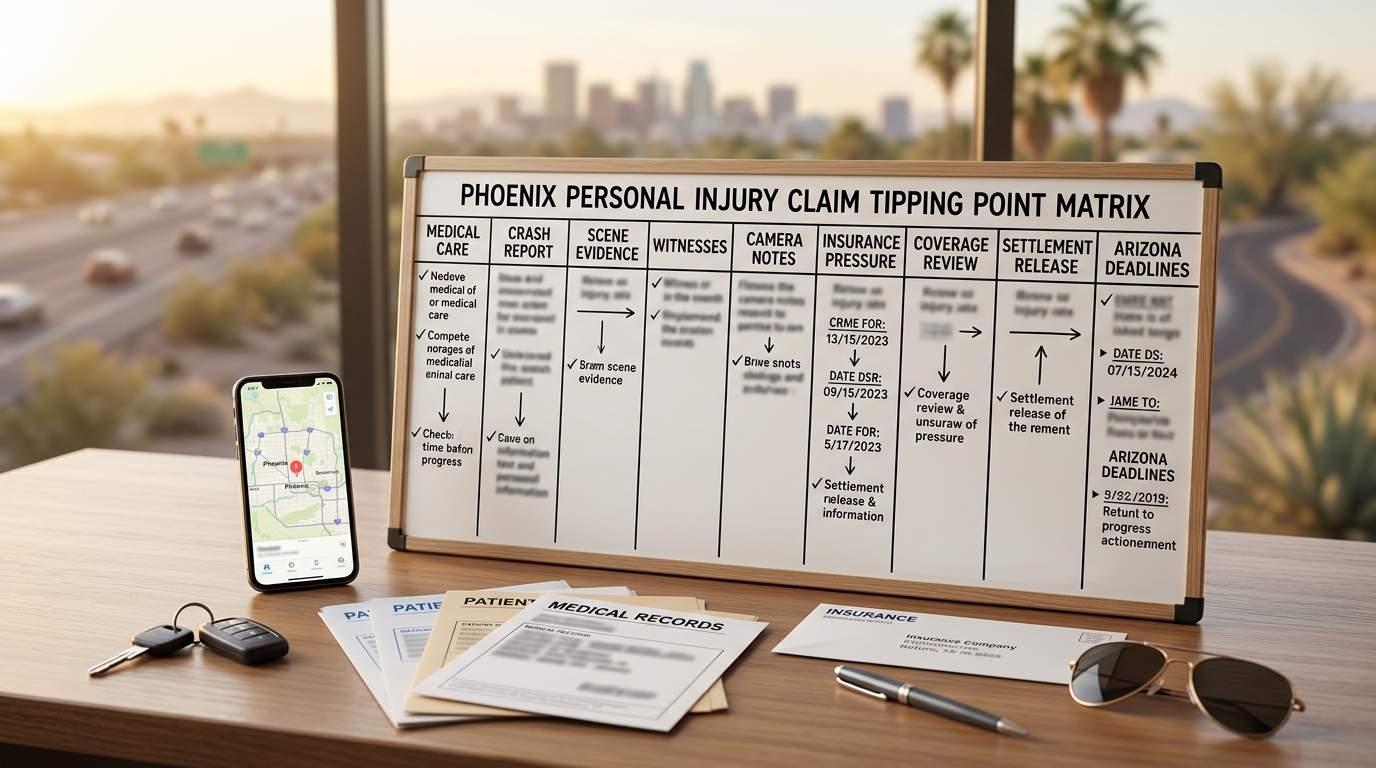
The Phoenix Claim Tipping-Point Matrix
A claim usually tips toward legal help when risk increases.
| Tipping Point | Why It Matters |
| You needed medical care | Injury documentation and treatment timing become important |
| Pain is ongoing | A quick settlement may be premature |
| Fault is disputed | Evidence can affect claim value |
| The insurer blames you | Arizona comparative-fault arguments may reduce value |
| Evidence could disappear | Cameras, witnesses, and vehicle data may need preservation |
| The driver fled or had no insurance | Your own policy may need review |
| A commercial or rideshare vehicle was involved | Multiple insurers and company records may matter |
| You were asked to sign documents | Releases and authorizations can affect rights |
| A public entity may be involved | Shorter notice and filing rules may apply |
| You are unsure about deadlines | Timing mistakes can damage the claim |
The more tipping points you see, the more important it may be to ask for legal guidance before giving detailed statements, signing documents, or accepting money.
Tipping Point 1: You Needed Medical Care
Medical care is one of the clearest signs that the claim may need closer attention.
Consider legal help if you received care from:
- Emergency medical services
- An emergency room
- Urgent care
- A primary care doctor
- An orthopedic specialist
- A neurologist
- An imaging center
- A physical therapist
- A pain management provider
- A surgeon
- A mental health provider for crash-related trauma
Insurance companies often review treatment timing. They may ask when symptoms started, whether the records mention the accident, whether care was delayed, whether appointments were missed, and whether treatment was consistent.
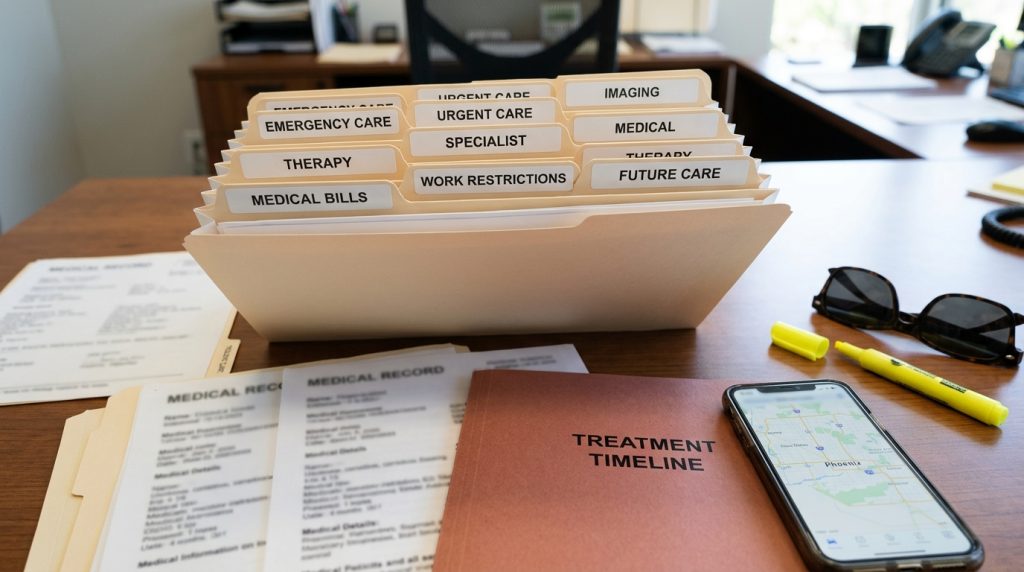
Save:
- Medical records
- Medical bills
- Discharge instructions
- Imaging reports
- Referral paperwork
- Prescription receipts
- Work restriction notes
- Therapy attendance records
- Follow-up appointment summaries
A lawyer may help explain how medical records fit into the claim, especially if the insurer questions whether the accident caused the injury.
Tipping Point 2: Symptoms Are Still Changing
Some injuries do not feel serious right away. Pain may appear later after adrenaline fades.
Watch for:
- Headaches
- Dizziness
- Confusion
- Neck pain
- Back pain
- Shoulder pain
- Knee pain
- Numbness or tingling
- Chest pain
- Abdominal pain
- Trouble sleeping
- Anxiety while driving
- Pain that affects work
- Symptoms that require imaging
- Symptoms that require therapy, injections, or surgery evaluation
If symptoms are still developing, settlement may be premature. A settlement release may close the claim before future treatment, lost wages, permanent symptoms, or long-term limits are clear.
Tipping Point 3: Fault Is Disputed
Fault disputes are a major reason to consider hiring a lawyer.
An insurance company may argue that you:
- Were speeding
- Failed to keep a proper lookout
- Followed too closely
- Changed lanes unsafely
- Ignored traffic conditions
- Were distracted
- Failed to avoid the crash
- Contributed to a fall or unsafe-property injury
- Delayed medical care
- Gave inconsistent statements
This matters because Arizona comparative negligence rules can affect claim value. If the insurer assigns part of the blame to you, evidence becomes more important.
Helpful evidence may include:
- Crash report
- Incident report
- Scene photos
- Vehicle damage photos
- Witness names
- Dashcam footage
- Nearby business cameras
- Traffic signal details
- Road layout photos
- Hazard photos
- Medical records
- Repair estimates
A lawyer may help identify evidence before it disappears and respond when the insurer tries to shift blame.
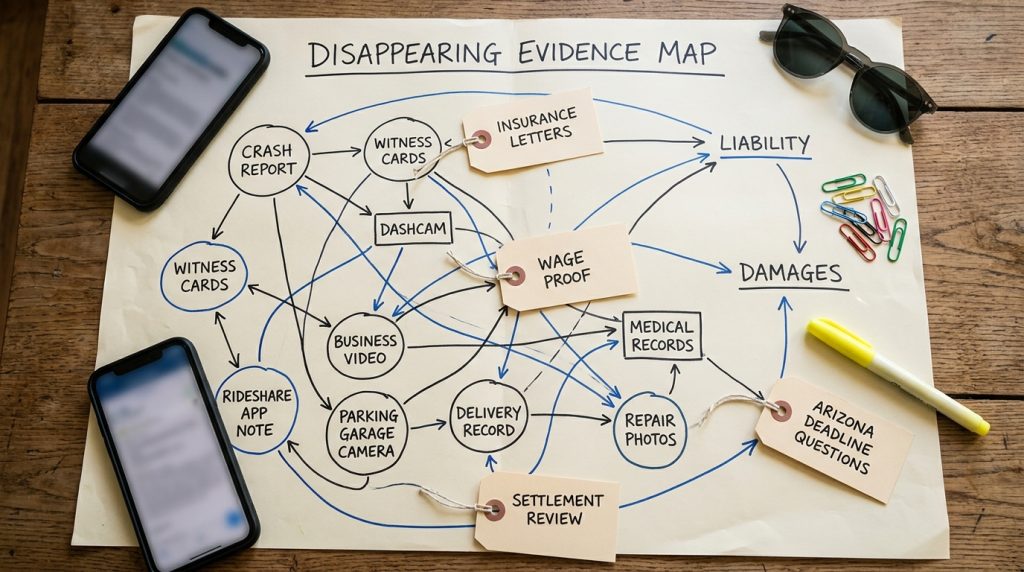
Tipping Point 4: Evidence Could Disappear Quickly
Phoenix accident scenes can change fast. Vehicles move, debris is cleared, hazards are repaired, witnesses leave, and camera systems may overwrite footage.
Time-sensitive evidence may include:
- Dashcam footage
- Business surveillance footage
- Apartment camera footage
- Gas station video
- Restaurant or hotel cameras
- Parking garage footage
- Rideshare app records
- Delivery app records
- Commercial vehicle camera data
- Vehicle black box data
- Witness memories
- Damaged vehicle inspection
- Photos before repair
- Hazard photos before cleanup
- Incident reports
- Maintenance records
- Construction-zone conditions
Phoenix accident settings where evidence may disappear quickly include I-10, I-17, Loop 101, Loop 202, State Route 51, US 60, downtown Phoenix, Camelback corridors, Arcadia, Roosevelt Row, airport-area routes, Grand Avenue, industrial areas, construction corridors, shopping centers, hotels, parking garages, restaurants, apartment complexes, gas stations, and rideshare pickup areas.
If camera footage, witness details, or commercial vehicle data may exist, the claim has likely moved beyond simple paperwork.
Tipping Point 5: The Crash Report or Incident Report Matters
A report can help create an official record of what happened.
For Phoenix motor vehicle crashes, Phoenix Police public-record materials include traffic crash records among request types and direct users to the Police Public Record Request portal. ADOT also provides Arizona Crash Report forms and resources.
A crash report may help document:
- Accident date
- Accident time
- Crash location
- Drivers
- Vehicles
- Insurance information
- Reported injuries
- Witnesses
- Citations
- Contributing factors
- Officer observations
- Report number
For unsafe property injuries, ask whether the store, apartment complex, hotel, restaurant, office building, parking garage, event venue, or property manager created an incident report.
Save:
- Report number
- Responding agency
- Officer name, if known
- Crash date
- Crash time
- Crash location
- Driver and vehicle information
- Insurance information
- Witness information
- Citation details, if any
- Notes about how the report was requested
A report helps, but it is not the whole claim. Medical records, photos, videos, witness details, repair documents, wage proof, and insurance letters may also matter.
Tipping Point 6: Insurance Pressure Has Started
Insurance companies may contact injured people quickly. Some requests are routine. Others require caution.
Be careful if an insurer asks for:
- A recorded statement
- A broad medical authorization
- A quick settlement
- A full release
- Statements about fault
- Statements about whether you are “fine”
- Prior medical history
- Social Security number or unrelated records
- A property-damage release that may affect injury claims
- A settlement before treatment is complete
Arizona DIFI advises drivers not to admit fault and not to discuss the accident with anyone except police and insurance representatives.
That does not mean you must guess, minimize symptoms, or answer questions you do not understand. Keep communication factual.
Avoid guessing about:
- Speed
- Distance
- Timing
- Visibility
- Fault
- Injury severity
- Future medical care
- Whether you are fully recovered
- What treatment will cost
If you do not know an answer, say you do not know.
Tipping Point 7: A Recorded Statement or Medical Authorization Was Requested
A recorded statement can create problems if it is incomplete, rushed, or based on guesses.
It may later be compared to:
- Crash reports
- Incident reports
- Medical records
- Photos
- Videos
- Witness statements
- Repair estimates
- Later testimony
- Social media posts
A broad medical authorization can also create risk if it gives the insurer access to unrelated medical history.
Before agreeing, ask:
- Who is requesting it?
- Is it your insurer or another party’s insurer?
- Is the request required by your policy?
- What topics will be covered?
- Is the medical authorization limited to accident-related treatment?
- What time period does the authorization cover?
- Can records be provided directly instead?
If you are unsure, that is a tipping point.
Tipping Point 8: The Other Driver Was Uninsured, Underinsured, or Fled
Uninsured, underinsured, and hit-and-run claims can be more complicated than standard claims.
Coverage that may matter includes:
- Uninsured motorist coverage
- Underinsured motorist coverage
- Collision coverage
- Medical payments coverage
- Health insurance
- Rideshare coverage, if applicable
- Commercial insurance, if applicable
Arizona law requires insurers writing automobile or motor vehicle liability policies to make uninsured and underinsured motorist coverage available by written notice. If the at-fault driver had no insurance, did not have enough insurance, or left the scene, your own policy may become important.
Do not assume there is no recovery path until available policies have been reviewed.
Tipping Point 9: A Commercial, Rideshare, Delivery, or Company Vehicle Was Involved
Some injury claims involve more than one person and one insurance policy.
Legal help may be useful when the accident involved:
- Tractor-trailer
- Box truck
- Delivery van
- Work truck
- Company car
- Construction vehicle
- Shuttle
- Bus
- Rideshare driver
- Food delivery driver
- Courier
- Medical transport vehicle
- Contractor vehicle
These claims may involve company records, commercial insurance, app records, dispatch logs, maintenance files, driver qualification records, vehicle cameras, cargo documents, and multiple responsible parties.
Phoenix commercial and rideshare evidence can be especially important near warehouses, airport-area routes, downtown hotels, medical campuses, construction corridors, retail centers, freeway interchanges, delivery zones, and industrial roads.
A standard insurance call may not identify every available coverage source or every company that should be reviewed.
Tipping Point 10: You Missed Work or Your Daily Life Changed
An injury claim may involve more than medical bills.
Save documentation for:
- Missed work
- Reduced hours
- Changed duties
- Used sick time
- Used vacation time
- Contractor income loss
- Business income loss
- Medical appointment travel
- Household help
- Childcare related to appointments
- Medical equipment
- Pain and daily limitations
Useful records include:
- Pay stubs
- Timesheets
- Employer letters
- Work restriction notes
- Tax records
- Contractor invoices
- Missed-shift confirmations
- Out-of-pocket receipts
- Recovery journal notes
If the accident changed your work, mobility, sleep, driving, family duties, or independence, the claim may need deeper evaluation.

Tipping Point 11: A Settlement Offer Arrived Early
A quick settlement offer may feel helpful when bills are coming in. But early offers often arrive before the full injury picture is clear.
Before accepting, ask:
- Is treatment complete?
- Are all medical bills included?
- Is future care expected?
- Are lost wages included?
- Are repair or rental issues separate?
- Are liens or reimbursement claims possible?
- Does the release cover all claims?
- Does it release only one party or multiple parties?
- Does it include unknown injuries?
- Is the payment final?
A settlement release can end the claim. Once signed, you may not be able to return later for additional medical bills, lost wages, or future symptoms.
Tipping Point 12: A Government Vehicle, Public Road Issue, or Public Entity May Be Involved
Some Phoenix injury claims have extra timing issues.
This can matter if the claim involves:
- A city vehicle
- A state vehicle
- A public employee
- A public school vehicle
- A public bus or transit-related issue
- A roadway defect
- A sidewalk condition
- A traffic signal issue
- A city-maintained property
- A public building
- A public agency
Arizona public-entity claims can involve notice and filing rules that are much shorter than the ordinary injury deadline. If any public entity may be involved, ask about timing immediately.
Arizona Deadlines and Fault Rules
Arizona injury claims are time-sensitive. In many cases, injury-to-person actions must be commenced and prosecuted within two years after the cause of action accrues under Arizona Revised Statutes Section 12-542.
Some claims have shorter rules. Under Arizona Revised Statutes Section 12-821.01, people with claims against a public entity, public school, or public employee must file a notice of claim with an authorized person within 180 days after the cause of action accrues. Arizona Revised Statutes Section 12-821 also sets a one-year limitation rule for actions against public entities or public employees.
Arizona law also addresses comparative negligence. Under Arizona Revised Statutes Section 12-2505, a claimant’s action is not barred by comparative negligence, but damages may be reduced in proportion to the claimant’s relative degree of fault.
That means evidence matters when an insurer argues that you were partly responsible.
How a Phoenix Personal Injury Lawyer May Help
A lawyer may help by:
- Reviewing the facts
- Identifying possible responsible parties
- Preserving evidence
- Requesting records
- Communicating with insurers
- Reviewing coverage
- Organizing medical documentation
- Evaluating wage loss
- Tracking deadlines
- Responding to fault disputes
- Reviewing settlement offers
- Explaining release documents
- Preparing the claim for negotiation or litigation
The goal is not simply to “file a claim.” The goal is to avoid losing evidence, missing coverage, undervaluing damages, or signing away rights too early.
What a Lawyer Should Explain Clearly
Before hiring a lawyer, you should understand:
- Who will handle your case
- How fees and costs work
- What communication to expect
- What records are needed
- What deadlines may apply
- What evidence could disappear
- What insurance coverage may matter
- What risks exist in the claim
- What the next steps are
- What the lawyer can and cannot promise
Be cautious if anyone guarantees a specific outcome before reviewing records.
How the State Bar of Arizona Can Fit Into Your Review
A local business profile can help you start. A law firm website can explain practice areas. The State Bar of Arizona also says consumers can use its member directory to search for lawyers by name, area of practice, or office location.
When comparing legal help, consider:
- Whether the lawyer handles your type of injury claim
- Whether the lawyer is licensed in Arizona
- Whether fees and case costs are explained clearly
- Whether communication expectations are clear
- Whether the first conversation identifies evidence that may disappear
- Whether the lawyer explains Arizona deadlines
- Whether the lawyer discusses insurance, medical records, and fault disputes in practical terms
Do not choose legal help based only on a map result. Use profile information, firm information, public attorney information, and consultation questions together.
Questions to Ask Before Hiring a Lawyer
Bring specific questions to the consultation:
- Have you handled cases like mine?
- What evidence should be preserved immediately?
- What records should I gather first?
- How do I get the crash report?
- Should I speak with the insurance adjuster?
- Should I give a recorded statement?
- Should I sign a medical authorization?
- What if I was partly at fault?
- What if the other driver has no insurance?
- What if a commercial vehicle was involved?
- What if camera footage may exist?
- What if I am still treating?
- What if a city, state, public school, or public entity may be involved?
- What Arizona deadlines should I know about?
- How do fees and case costs work?
- Who will update me?
- What happens next?
A good consultation should turn confusion into a practical action plan.
Phoenix Hiring Decision Checklist
Use this checklist to decide whether the claim has reached a tipping point.
Call Soon If
- You were injured
- You went to the ER or urgent care
- Pain is ongoing
- Treatment is not finished
- You missed work
- Fault is disputed
- The insurer blames you
- The other driver fled
- The other driver had no insurance
- A commercial or rideshare vehicle was involved
- A child was injured
- A loved one died
- A settlement offer arrived early
- You were asked for a recorded statement
- You were asked to sign a broad medical authorization
- A public entity may be involved
- You are unsure about deadlines
Prepare Before Calling
- Accident date and location
- Report number
- Photos and videos
- Medical records
- Medical bills
- Insurance letters
- Repair estimates
- Wage proof
- Witness information
- Camera-location notes
- Settlement documents
- Questions you want answered
FAQ
When should I hire a Phoenix personal injury lawyer?
Consider hiring a Phoenix personal injury lawyer when you were injured, needed medical care, missed work, face disputed fault, have insurance delays, received a low settlement offer, or were asked for a recorded statement or broad medical authorization.
Do I need a lawyer for every injury claim?
No. Some minor claims may be handled without a lawyer. Legal help becomes more important when injuries, insurance disputes, missing evidence, coverage issues, settlement releases, or Arizona deadlines create risk.
Should I talk to the insurance adjuster before hiring a lawyer?
You may need to provide basic facts, but avoid guessing, admitting fault, minimizing injuries, signing broad authorizations, or discussing settlement before you understand the full injury and claim value.
What if the insurance company says I was partly at fault?
Arizona comparative negligence rules can affect claim value. Evidence such as photos, videos, witness statements, crash reports, medical records, and repair estimates can become important.
What if the at-fault driver does not have insurance?
Your own uninsured motorist coverage, underinsured motorist coverage, collision coverage, medical payments coverage, health insurance, or other available coverage may need review depending on the policy and facts.
What if I am still treating?
Be careful about settling before treatment is complete. A settlement release may end the claim before future medical needs, wage loss, or long-term symptoms are clear.
What should I bring to a consultation?
Bring the accident date, location, report number, photos, videos, medical records, bills, insurance letters, repair estimates, wage proof, witness details, camera notes, and any settlement documents.
How long do I have to file a personal injury lawsuit in Arizona?
In many Arizona injury cases, the general deadline is two years after the cause of action accrues. Some claims may involve shorter notice rules or different deadlines, especially if a public entity, public school, or public employee may be involved.
How can I check attorney information in Arizona?
The State Bar of Arizona says consumers can use its member directory to search for lawyers by name, area of practice, or office location.
Is this article legal advice?
No. This article is for general informational purposes only. Anyone dealing with a specific accident or injury claim should speak with a qualified legal professional about their situation.
Final Thoughts
You do not need to hire a personal injury lawyer for every minor accident. But you should strongly consider legal help when the claim reaches a tipping point: medical care, ongoing pain, disputed fault, insurance pressure, missing evidence, uninsured drivers, commercial vehicles, missed work, settlement releases, public-entity issues, or Arizona deadlines.
The safest approach is to organize your records, preserve evidence early, communicate carefully with insurers, and ask questions before signing anything final.
About the Author